
Transcribing a few recordings is simple. Processing hundreds or thousands of hours of meetings, customer calls, interviews, and case files is an entirely different problem. At that scale, speed still matters, but so do accuracy, security, file management, collaboration, and what happens after the transcripts are created.
That is where enterprise transcription solutions come in. A fast speech-to-text engine alone is not enough.
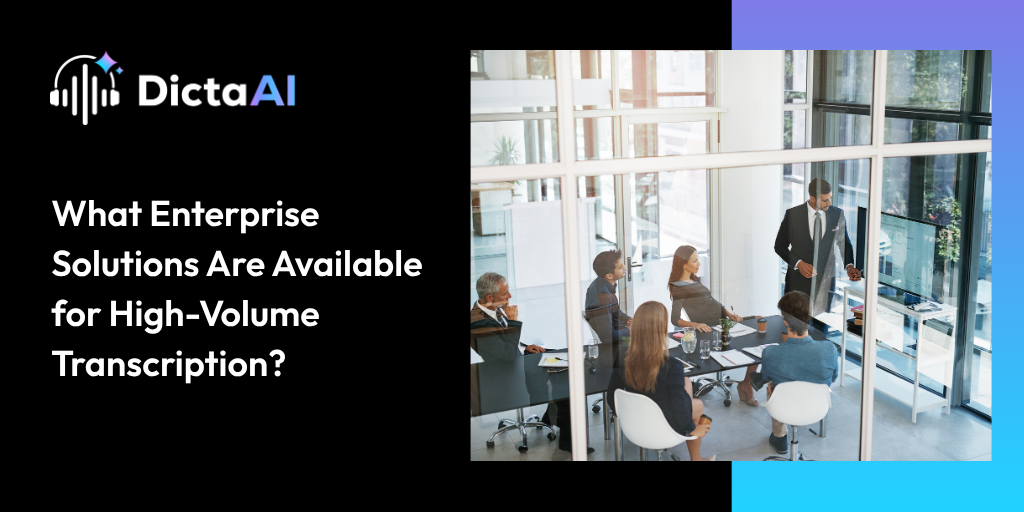
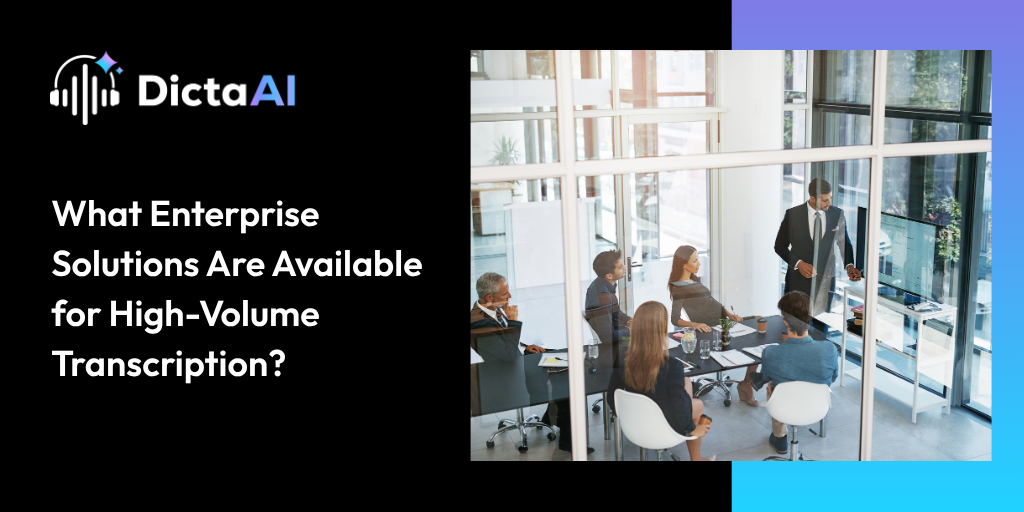
A single department might record a few interviews a month. A larger organization can generate thousands of files across meetings, customer calls, interviews, training sessions, and archived media, often in multiple languages and from multiple teams. That shift changes what matters in enterprise transcription software: large-volume processing, long recordings, multiple speakers, predictable turnaround, centralized file management, and consistent output across projects.
The lowest price per minute is not the only consideration here. The workflow built around the transcript, how it gets reviewed, stored, searched, and used, matters just as much as how fast it gets produced.
DictaAI's AI transcription processes audio and video automatically, without waiting for a transcriptionist to work through each file by hand. That suits meetings, research interviews, internal recordings, customer conversations, and large audio archives where speed matters and the material isn't especially high stakes. Standard AI transcription runs at over 90% accuracy, depending on recording quality, with speaker labeling, timestamps, and filler-word removal built in.
Some material calls for more than automation alone. AI + Human Review service adds a proofreading layer where trained editors correct the AI-generated transcript, pushing accuracy above 98%. Review plans scale by turnaround time and audio difficulty, from two-day priority review down to standard five-plus-day turnaround, and from a straightforward Standard Format up to a more detailed Special Format for files that need extra care.
A large organization might have thousands of routine recordings and only a smaller set of files that carry real weight: a board meeting, a sensitive client call, a compliance-related interview. Running every file through the most thorough human review gets expensive and slow fast. Running everything through AI alone, with no review, doesn't give the highest-stakes files the scrutiny they deserve.
A tiered approach tends to work better in practice:
Having both AI transcription and a flexible human review layer under one platform means an enterprise can make that call file by file instead of picking one method for everything.
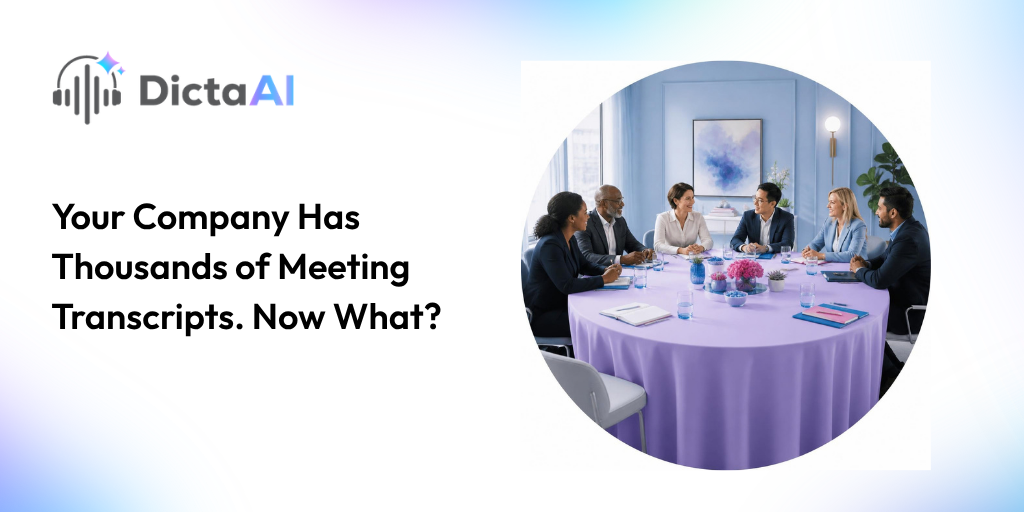
Processing 5,000 recordings creates a second problem: what happens to 5,000 transcripts. Downloading and storing them doesn't make the information inside them useful on its own. Enterprises need a way to search, revisit, and actually analyze what's sitting in their transcript archive.
Also Read: Your Company Has Thousands of Meeting Transcripts. Now What?
This is where high-volume transcription starts to overlap with conversation intelligence. DictaLens, DictaAI's analysis layer, lets teams select multiple transcripts at once and ask questions across the whole set instead of rereading every file individually. Multi-file analysis can surface recurring themes, repeated problems, contradictions between conversations, and connections that would be nearly impossible to spot by skimming files one at a time.
Enterprise knowledge is rarely limited to recordings, either. A project might include reports, case material, or research documents alongside the audio. DictaLens can analyze uploaded PDFs (up to 350 pages) alongside DictaAI transcripts in the same session, so teams can see how what people said lines up with what's written down.
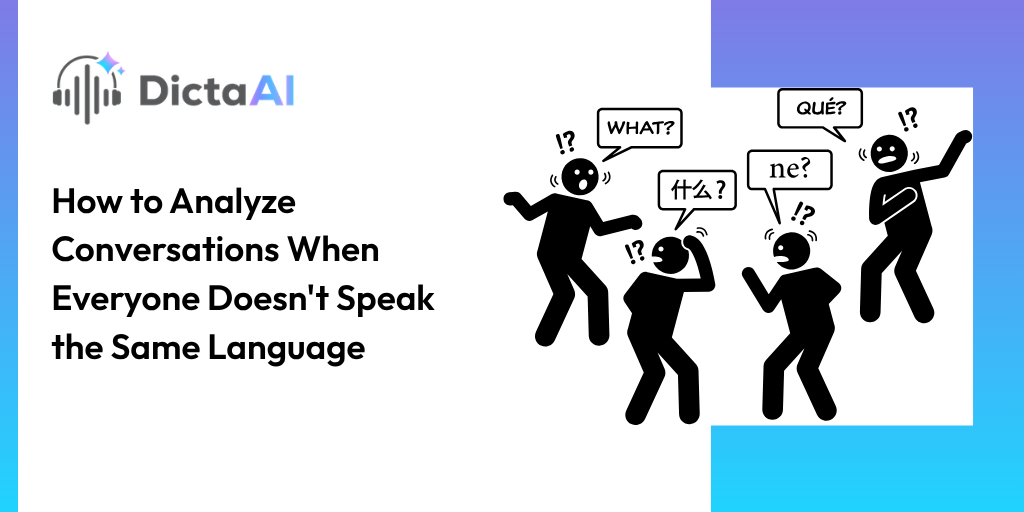
International organizations often receive recordings from multiple countries and teams, and some conversations switch languages mid-sentence rather than staying in one. DictaAI transcribes in 13 languages and supports mixed-language conversations, including Hinglish, Spanglish, and Franglais, at accuracy that typically runs between 85% and 95% depending on audio quality and accents. That lets an enterprise bring more of its international conversation data into one workflow instead of routing different languages to different tools.
Also Read: How to Analyze Conversations When Everyone Doesn't Speak the Same Language
High-volume transcription is usually a team activity, not one person's job. DictaAI's Business plan is built for that, with team collaboration tools and a team admin dashboard alongside 25 hours of monthly transcription and automated meeting capture through Zoom, Google Meet, and Microsoft Teams integrations. That gives agencies, research teams, legal teams, and businesses with fluctuating transcription demand a shared workspace instead of separate individual accounts to manage.
For volumes beyond what a standard plan covers, DictaAI supports enterprise billing and bulk audio transcription pricing on request, along with API access for teams that want to fold transcription directly into their own workflows.
A few practical questions help narrow the decision:
Choosing an enterprise transcription solution shouldn't come down to who converts the most audio hours into text at the lowest price. What happens before, during, and after transcription matters just as much: how files get routed to the right level of review, how a growing transcript archive stays searchable, and how well the platform handles the languages an organization actually uses.
DictaAI brings AI transcription, tiered human review, multilingual support, team collaboration, and DictaLens analysis together in one workflow. Organizations with large or specialized requirements can contact DictaAI to discuss a custom Enterprise arrangement.
What is the best way to transcribe thousands of hours of audio and video?
A tiered workflow tends to work best: automated AI transcription for routine, high-volume files, and AI + Human Review for recordings where accuracy carries more weight. Pairing that with a tool like DictaLens for multi-file analysis keeps a large transcript archive searchable instead of just growing unused.
How does enterprise AI transcription differ from standard transcription services?
The core transcription technology is similar. What changes at enterprise scale is centralized file management, predictable turnaround across large volumes, team collaboration, multilingual support, and a way to analyze the resulting transcripts rather than just store them.
When should enterprises choose AI transcription versus human-reviewed transcription?
Automated AI transcription generally suits routine, high-volume material like internal meetings or research interviews. AI + Human Review makes more sense for recordings where errors carry real consequences, since the review layer can be scaled up with priority turnaround for the files that need it most.
Can DictaAI handle multilingual and high-volume transcription projects?
Yes. DictaAI transcribes in 13 languages and supports mixed-language conversations such as Hinglish, Spanglish, and Franglais, alongside the file-handling and team collaboration features built for higher-volume use.
Can businesses analyze multiple transcripts together after transcription?
Yes. DictaLens supports multi-file analysis, letting teams select several transcripts (and supporting documents) and ask questions across the full set instead of reviewing each file individually.

Comments
Glynnis Campbell
This is a test comment!