
A customer mentioned the same complaint on three different calls this quarter. A project risk got flagged, then quietly dropped, then flagged again two months later. Somewhere in an old planning meeting, someone explained exactly why you made a call you're now second-guessing. It's all sitting in your meeting transcripts, doing nobody any good, because nobody has time to reread a thousand meetings to find it.
Companies record and transcribe more meetings than ever, and AI transcription makes capturing every word effortless. But capturing what was said was never the hard part. The hard part is what you do with it once the archive reaches the thousands and outnumbers anyone's memory. That's the gap AI meeting analysis closes.
A transcript preserves what was said, but preservation is not the same as usefulness. Searching a transcript for a keyword only helps when you already know what you're looking for and exactly how it was phrased. The same idea often gets expressed differently across meetings: one team calls it a "delay," another calls it a "scheduling risk."
That gap shows up constantly. Employees struggle to remember:
Most meeting tools make this worse by treating every meeting as an isolated event. But a lot of the useful information only becomes visible when conversations are looked at together: the same customer complaint surfacing across several calls, a project risk mentioned in three separate meetings, a deadline that quietly moved between one planning session and the next. Meeting transcript analysis matters more, not less, as the archive grows.
Once you can analyze groups of related transcripts instead of opening them one by one, patterns start to surface that a single meeting summary would never show. Recurring topics, common customer concerns, repeated operational problems, and shifting priorities over time all become visible when transcripts are read as a set instead of individually.
That context matters. A single meeting summary tells you what happened in one hour. A pattern across twenty meetings tells you what's actually going on in the business.
Some of the most useful questions about a decision cannot be answered by any one transcript:
Answering those questions well usually means piecing together several conversations that happened weeks or months apart, which is exactly the kind of work nobody has time to do manually.
The same multi-meeting view also makes it easier to catch contradictions before they cause real problems. One team may agree to something that another team later discusses differently. A client requirement can shift without everyone realizing it changed. A commitment made in one meeting can quietly conflict with a decision made in a later one. Surfacing those inconsistencies across transcripts for a human to review is far more reliable than hoping someone happens to remember.
A lot of valuable company knowledge only ever exists in conversation. When an employee leaves or a project wraps up, that context can disappear with them. Project reasoning, client requirements, past solutions, and product decisions often live nowhere except old meeting recordings.
Making that history retrievable means current teams stop repeatedly asking, "Does anyone remember why we did this?" and start finding the answer themselves, in minutes instead of by tracking down whoever happens to still be around.
Also Read: How DictaAI Turns Meeting Conversations into Searchable Business Intelligence
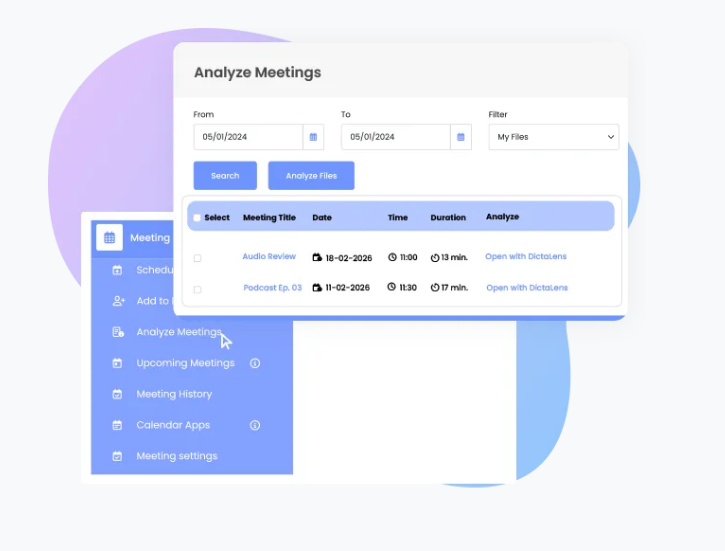
Conversations rarely tell the whole story on their own. Relevant context often lives in reports, requirements documents, and other project material alongside the transcripts. DictaLens, DictaAI's analysis layer, is built to work across multiple transcribed files and uploaded PDFs at once, so teams can look at meetings and supporting documents together rather than treating them as separate sources. A team might compare what was actually discussed across several project meetings against the project's written requirements, for example, to see where the two have drifted apart.
In practice, that means selecting the relevant transcripts (and any PDFs that add context), then asking questions across that selected material using DictaLens's Multi-File Intelligence. Instead of manually reading every file, you can ask what themes, decisions, or connections run through the set and get an answer grounded in the actual conversations, not a guess.
Transcription should be the beginning of the workflow, not the end of it. An archive of thousands of transcripts becomes more valuable as it grows, but only if someone can actually analyze it. AI meeting analysis is what makes that possible: it turns a pile of recordings nobody has time to reread into patterns, decisions, and knowledge the whole team can use.
Thousands of transcripts do not have to become thousands of forgotten files. If your team already has an archive of recorded meetings, the DictaLens guide walks through exactly how to start surfacing what's inside it.
Explore DictaAI for business to see how conversation intelligence fits into your existing meeting workflow.
How can AI analyze thousands of meeting transcripts?
AI meeting analysis tools like DictaLens let you select multiple transcribed files at once and ask questions across all of them together, rather than opening and rereading each meeting individually. This makes it possible to work through a large archive in minutes instead of days.
What insights can companies find by analyzing multiple meeting transcripts together?
Looking at meetings as a group can surface recurring customer concerns, repeated operational problems, shifting project priorities, and decisions that changed over time. These are patterns a single meeting summary would not show on its own.
Can AI identify recurring themes and patterns across different meetings?
Yes. Multi-file analysis is designed specifically to find topics, concerns, and problems that show up across several conversations, even when different speakers described them in different words.
How can old meeting transcripts be turned into useful organizational knowledge?
Historical transcripts often hold project reasoning, client requirements, and past solutions that would otherwise only exist in someone's memory. Making that archive searchable and analyzable turns it into institutional knowledge the whole team can draw on, not just the people who were in the room.
Can DictaAI analyze multiple meeting transcripts and documents together?
Yes. DictaLens supports selecting multiple transcribed files along with uploaded PDFs, so teams can analyze meeting conversations alongside supporting documents like reports or requirements in a single pass.

Comments
Glynnis Campbell
This is a test comment!