
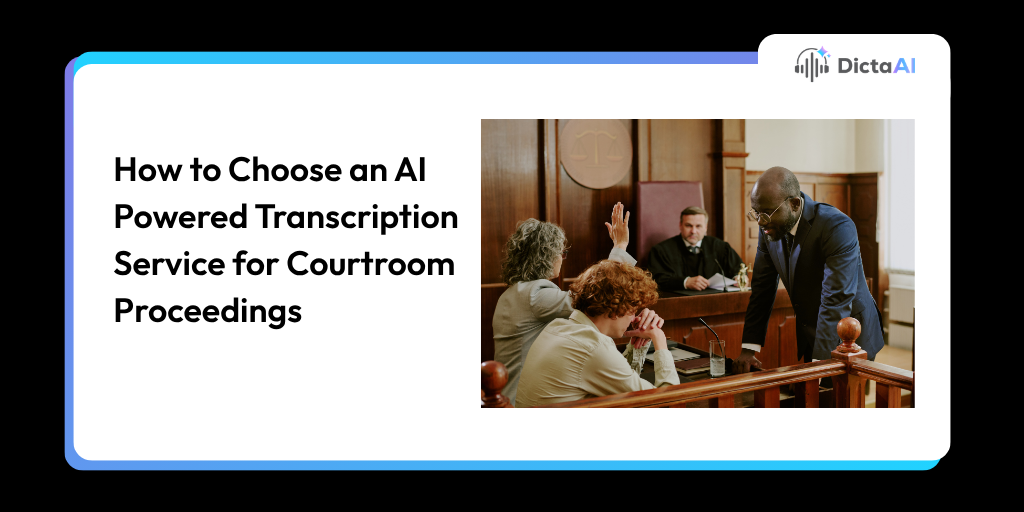
A three-hour deposition can contain one sentence that changes how a legal team approaches the case. The challenge is finding it quickly, especially when testimony, hearings, witness statements, and recorded evidence start piling up.
That is where AI-powered legal transcription can help. The right service turns lengthy recordings into searchable text, makes it easier to track speakers and terminology, and helps teams review what was said without replaying hours of audio.
But legal transcription has higher stakes than ordinary speech-to-text. Accuracy, confidentiality, human review, and the intended use of the transcript all matter when choosing a platform.
Not every legal transcript exists for the same reason. A legal team might need one to review a recorded proceeding, prepare for a case, search testimony, review a deposition, support internal research, or analyze recorded evidence. The right transcription method depends partly on what that transcript is actually for.
This is also where an important distinction matters: an AI-generated working transcript is not automatically the same thing as an official or certified court transcript. Courts and jurisdictions set their own requirements for what counts as an official record, independent of any transcription tool. AI transcription is well suited to research, review, and case preparation. Whether it can stand in for an official transcript is a separate question, one a firm needs to answer against the applicable court rules.
A few capabilities separate a general transcription tool from one that holds up for legal work:
AI transcription tends to earn its place when a legal team has a real volume of recordings to get through. Instead of replaying an entire hearing or deposition from the start, attorneys can begin with a searchable transcript, locate the relevant section, and jump back to the exact moment in the recording if they need to confirm the wording.
DictaAI's AI transcription services generate transcripts within minutes rather than the days that traditional legal transcription often takes, with automatic speaker labeling and timestamps built in. For firms managing a large collection of recorded evidence, that speed difference is what makes the material easier to organize and review, not just faster to produce.
Also Read: The Most Valuable Legal AI Tools for Law Firms in 2026
Legal material carries names, case references, technical terminology, overlapping speakers, and sometimes genuinely poor audio. AI-generated transcripts deserve a closer look when the stakes justify it.
DictaAI's AI + Human Review service adds trained editors on top of the AI transcript, with plans that scale by turnaround time, speaker count, and audio difficulty, from a two-day priority pass to a more thorough Special Format review. Human review is currently available for English (and its variants) and Hindi.
Not every recording needs that level of review. Applying the most thorough, most expensive method to every file is rarely necessary; the review level should match what's actually riding on the file, since an internal strategy call carries different stakes than a witness deposition.
A large matter can involve dozens of hearings, depositions, interviews, and recorded statements. Finding one statement is easy with a single transcript. It gets much harder across a hundred of them.
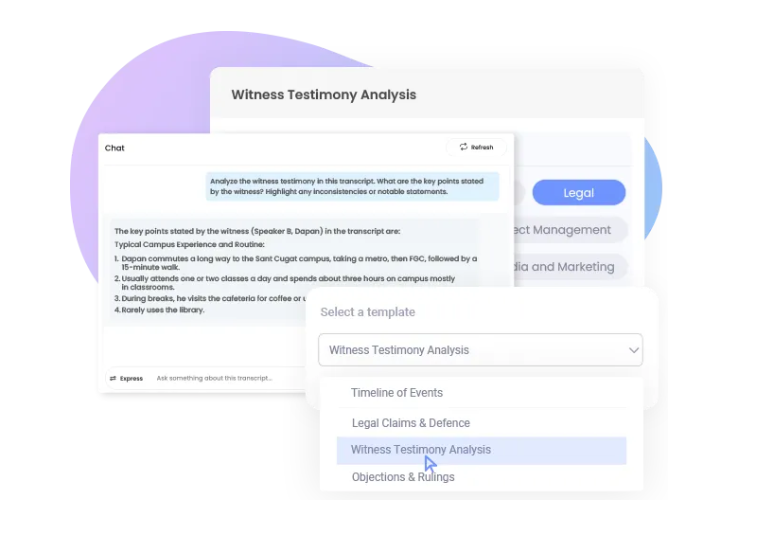
DictaLens extends the workflow from transcription into analysis. Legal teams can select multiple transcripts and ask questions across the whole set: where a particular event came up, what different witnesses said about the same issue, where accounts seem to diverge, when a person or organization was mentioned, and which topics keep recurring. AI can help surface material worth a closer look; legal professionals still need to determine what it means and verify it against the source recording.
Legal matters rarely consist only of recordings. A case might include reports, statements, and correspondence alongside the audio. DictaLens can analyze uploaded PDF documents alongside DictaAI transcripts in the same session, so a team can see how what was said in a deposition lines up with what's written in the case file.
Also Read: How AI Transcription Services Are Transforming Legal Workflows in 2026
Legal matters can involve witnesses, clients, or evidence in more than one language, and some speakers switch languages mid-conversation rather than sticking to one. DictaAI's multilingual transcription covers more than 10 languages along with mixed-language cases like Hinglish, Spanglish, and Franglais, which matters for cross-border matters and multilingual evidence review. Any translation or interpretation that carries legal weight should still go through appropriate professional review before it factors into a filing or a decision.
Not automatically, and this is worth being direct about. AI transcription and official court reporting aren't interchangeable by default. Courts and jurisdictions set their own requirements for certification, court reporters, interpreters, and what counts as admissible in official proceedings, and those requirements don't change based on which transcription tool a firm uses.
DictaAI is built for transcription, review, research, evidence organization, and analysis, work that makes up a large share of what legal teams do day to day. Whether an AI-generated transcript can serve as an official court record in a specific matter is a question a firm needs to run past the applicable court rules and, where needed, a qualified legal professional.
For legal professionals, the useful question isn't just where to get a recording transcribed. It's what needs to happen after the transcript exists: searching testimony, comparing statements across witnesses, connecting transcripts to case documents, and getting back to the original recording when something needs confirming.
DictaAI combines court transcription software with the review options and analysis tools that support that fuller workflow. Explore DictaAI for legal transcription, or contact DictaAI to discuss higher-volume or specialized legal transcription requirements.
Can AI transcription be used for courtroom and legal proceedings?
Yes, for working transcripts that support case preparation, testimony review, and legal research. Whether an AI-generated transcript can serve as an official court record is a separate question governed by the specific court's rules, not by the transcription tool itself.
How accurate is AI transcription for legal and courtroom recordings?
DictaAI's standard AI transcription typically runs over 90% accurate, and English transcripts can reach into the high 90s under clear audio conditions. Accuracy depends on recording quality, accents, overlapping speakers, and background noise, which is why higher-stakes material often benefits from AI + Human Review.
Can an AI-generated transcript be used as an official court transcript?
Not automatically. Courts and jurisdictions set their own certification and admissibility requirements for official transcripts. Legal teams should confirm those requirements before relying on any AI-generated transcript for filings or court submissions.
Can DictaAI analyze multiple depositions, hearings, or witness transcripts together?
Yes. DictaLens supports multi-file analysis, letting legal teams select several transcripts and documents and ask questions across the full set to find patterns, connections, and contradictions.
When should legal teams choose human-reviewed transcription instead of AI transcription?
When the consequences of an error are high enough to justify it, depositions or key witness testimony, for example. DictaAI's AI + Human Review service scales by turnaround time and audio difficulty, so teams can apply a lighter or heavier review pass depending on what's at stake.

Comments
Glynnis Campbell
This is a test comment!