

A legal matter can generate hundreds of pages before anyone reaches the courtroom. Contracts, witness statements, deposition transcripts, correspondence, reports, and supporting evidence all need to be reviewed, connected, and revisited as the case develops.
The challenge is rarely a lack of information. It is finding the right information quickly without losing context.
That is where AI-powered legal workspace solutions can help. By combining document analysis, transcription, multi-file review, and AI-assisted question answering, these tools can reduce the time spent sorting through legal information while keeping lawyers in control of the final interpretation.
Legal review is demanding because important details rarely sit neatly in one place.
A single matter may require a legal team to compare:
Finding one clause in a contract may be straightforward. Understanding how that clause relates to a statement made during a deposition, a date in another document, and a later client discussion is much harder.
Manual review also requires lawyers and paralegals to repeatedly extract names, dates, obligations, claims, and other details from lengthy records.
AI legal document review can reduce some of that repetitive work, allowing legal professionals to spend more time evaluating what the information actually means.
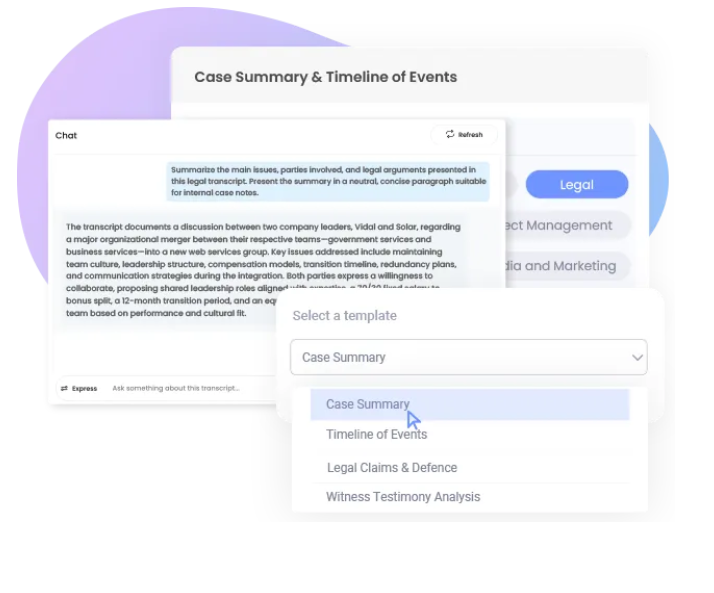
An AI-powered legal workspace brings several information-processing tasks into a more connected workflow.
Depending on the platform, it may help teams:
The goal is not to have AI make legal decisions.
It is to make large amounts of information easier to review.
That distinction matters. A useful legal AI tool should reduce the time spent finding and organizing information while leaving legal reasoning, interpretation, and strategy with qualified professionals.
Also Read: Are Defense Attorneys Turning to AI? Here’s What’s Changing in Legal Workflows
One of the most useful applications of AI-powered legal document analysis is the initial review.
Imagine receiving a 200-page case file. Reading every page remains important when the matter requires it, but AI can help the reviewer understand the structure of the material before beginning a detailed examination.
For example, an AI workspace may help surface:
This gives the legal team a starting point.
Instead of beginning with an unstructured stack of material, reviewers can identify where they need to focus their attention and then return to the original documents for verification.
Many legal questions cannot be answered from a single document.
A witness may describe an event one way during an interview and differently during a later deposition. A contract may contain an obligation that is discussed differently in meeting transcripts. An important date might appear across several records.
That is where multi-document analysis becomes especially useful.
Rather than opening each file independently, legal teams can analyze relevant records together and ask questions such as:
AI can help surface those connections. A lawyer still needs to verify the underlying material and determine whether any difference is legally significant.
Legal work is not limited to written documents.
Depositions, interviews, consultations, hearings, negotiation meetings, and internal case discussions can all generate hours of recorded material.
DictaAI's legal transcription services can turn those recordings into transcripts with speaker labels and timestamps, making the conversation easier to review and reference.
For material where greater accuracy is required, DictaAI also offers AI + Human Review, adding professional review to the AI-generated transcript.
This creates a useful distinction in a legal workflow:
Transcription captures what was said. Analysis helps determine what in that conversation deserves attention.
That second step is where legal teams can start connecting recorded testimony with the rest of the case material.
A single deposition transcript might answer a specific question.
A larger matter could involve ten depositions, several witness interviews, internal discussions, and supporting documents.
Reviewing each transcript separately makes it difficult to see what repeats across the matter.
DictaLens, DictaAI's analysis layer, allows users to select multiple transcripts and analyze them together. Legal teams can also work with uploaded PDFs alongside transcript material.
That makes it possible to ask questions across a selected group of files instead of treating every record as an isolated source.
For example, a legal team could use DictaLens to explore:
DictaLens also provides legal-specific prompts through its Idea Palette, while the Ask Anything feature allows users to enter their own questions.
The analysis is based on the selected source material, which is particularly important in legal work where an answer must be traceable back to the underlying records.
A confident-sounding AI answer is not useful if the information was never in the case material.
General-purpose AI systems can sometimes generate plausible information that is unsupported by the source. In legal work, even a small invented detail can create unnecessary risk.
For that reason, legal AI tools should make it easier to distinguish between:
DictaLens is designed to generate its analysis from the files selected by the user rather than introducing unrelated outside information.
That does not eliminate the need for verification. Lawyers should still return to the original document, recording, or transcript before relying on an AI-generated finding in a filing, legal opinion, negotiation, or other consequential decision.
The same workflow can support several types of legal work.
AI can help organize case materials, summarize recorded testimony, identify important dates, and surface information across related files.
For complex matters, this can help the legal team develop a clearer picture before conducting deeper review.
Transcription turns recorded testimony into text that can be reviewed more efficiently.
Multi-file analysis can then help compare accounts across different interviews or depositions and identify statements that warrant closer examination.
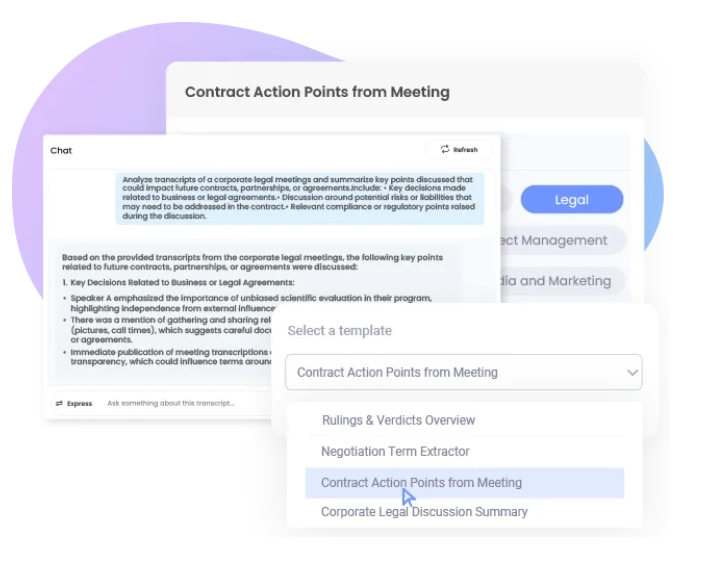
Recorded negotiation meetings often contain commitments, proposed terms, deadlines, and unresolved questions.
Transcribing those discussions can help legal teams capture what was discussed and use AI analysis to organize important points before returning to the actual contract.
AI-generated notes should support contract review, not replace a lawyer's examination of the governing document.
Document-heavy internal investigations may involve interviews, policies, reports, and recorded discussions.
AI-assisted analysis can help organize that information and surface recurring topics, dates, or statements for human reviewers to examine more closely.
Not every tool described as AI for lawyers is designed for the same job.
Before adopting legal document review software or an AI-assisted workspace, legal teams should look beyond the feature list and consider how the platform will fit into their actual workflow.
Important questions include:
Security deserves particular attention. DictaAI states that files and transcripts are encrypted in transit and at rest, supports controlled access and PII redaction, and does not use uploaded customer files to train its AI models.
For any highly sensitive or regulated matter, the organization's own confidentiality, retention, privilege, and compliance requirements should still guide the final decision.
The most useful role for AI in legal document review is not replacing the lawyer.
It is reducing the amount of repetitive information processing that happens before legal judgment can begin.
AI can help summarize a transcript.
A lawyer decides whether the summary captured what matters.
AI can surface two statements that appear inconsistent.
A lawyer determines whether the difference is meaningful.
AI can organize dates from several files.
A legal professional decides how those events fit into the case.
That human-AI division is important because legal work depends on context, jurisdiction, evidentiary rules, professional responsibility, and strategic judgment that cannot be reduced to document extraction alone.
The value of AI-powered legal workspace solutions is not simply that they make documents faster to read. Their bigger advantage is helping legal teams connect information that would otherwise remain scattered across transcripts, recordings, and case documents.
DictaAI supports that workflow by combining AI transcription for legal professionals with DictaLens analysis across transcripts and supporting PDFs. Teams can use it to organize recorded testimony, examine multiple files together, ask questions about selected material, and surface information for closer legal review.
The technology can reduce the time spent sorting through information. The lawyer still decides what that information means.
Explore DictaAI to see how transcription and AI-assisted analysis can fit into your legal workflow.
What is an AI-powered legal workspace solution?
An AI-powered legal workspace solution uses AI to help organize, summarize, compare, and analyze legal information. Depending on the platform, it may support document analysis, transcription, natural-language questions, multi-file review, and other tasks that make large legal records easier to work with.
How does AI accelerate legal document review?
AI can assist with the initial review by summarizing lengthy material, extracting important information, comparing several files, and helping users locate relevant points through natural-language questions. Legal professionals should still verify important findings against the original source.
Can AI review legal documents accurately?
AI can assist with legal document review, but its outputs should not be treated as automatically correct. Accuracy depends on the source material, the platform, the task, and the quality of the input. Important facts, quotations, dates, and legal conclusions should always be verified by a qualified professional.
Can DictaAI analyze legal documents as well as transcripts?
Yes. DictaLens can analyze DictaAI transcripts and uploaded PDF documents. It also supports multi-file analysis, allowing users to ask questions and explore patterns across selected source material.
Can AI summarize depositions and witness statements?
Yes. Once recorded testimony has been transcribed, AI tools can generate summaries and help identify important statements or recurring topics. Those outputs should be checked against the original transcript or recording before they are used for legal purposes.
Can AI replace lawyers in legal document review?
No. AI can reduce repetitive review work and help organize information, but legal interpretation, strategy, professional judgment, and final verification remain the responsibility of qualified legal professionals.

.png)

Comments
Glynnis Campbell
This is a test comment!