

Legal defense work has always been intense. You’re dealing with hours of recordings, detailed testimonies, and stacks of documents, all under tight deadlines.
What’s changing today isn’t the complexity. It’s how attorneys handle that complexity.
More defense attorneys are starting to use AI to manage information faster and more efficiently. Instead of relying only on manual processes, they are using AI transcription services, legal transcription services, and legal document analysis to prepare cases with greater speed and clarity.
This shift isn’t about replacing legal expertise. It’s about giving attorneys better tools to work with.
Across legal practice, there is a clear shift happening.
Attorneys are moving from time-heavy manual review to more assisted workflows. Instead of spending hours going through recordings and documents, they can now access structured information much faster.
Here’s what’s driving that change:
Defense work involves managing a lot of moving parts at once.
Think about what attorneys deal with daily:
Now add time pressure.
Traditional workflows make it difficult to:
AI helps simplify this. It brings structure to what would otherwise be scattered and time-consuming to manage.
Manual processes have been the backbone of legal work for years, but they come with limitations.
For example, attorneys often rely on notes taken during meetings or hearings. These notes may not capture everything. Court transcription can take time to arrive, and when it does, it’s usually in a format that isn’t easy to search or analyze.
This creates challenges like:
Also Read: Is AI the New Edge in Legal Education?
This is where AI starts to make a real difference.
With AI transcription services, attorneys can convert audio or video into structured text in minutes instead of hours or days. That alone changes how quickly they can move through case material.
More importantly, these transcripts are searchable.
That means you can:
At the core of this shift is transcription.
Defense attorneys rely heavily on accurate records of conversations and proceedings. This is where legal transcription services and court transcription come into play.
AI tools now help capture and convert:
This ensures nothing is missed and everything is documented clearly.
Transcripts are valuable, but they’re just the starting point.
The real advantage comes from legal document analysis.
Instead of reading through long transcripts manually, attorneys can work with structured insights. AI can help:
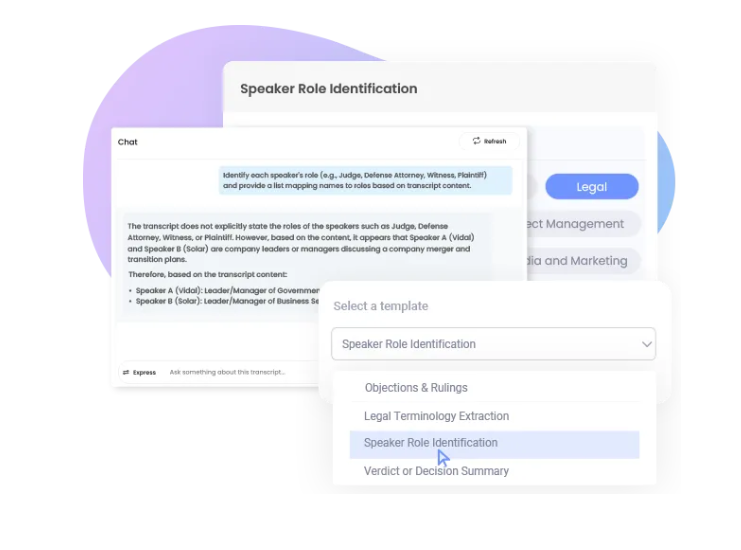
DictaAI brings all of this together in one place.
It combines AI transcription services with built-in legal document analysis, allowing attorneys to turn recordings and documents into structured, searchable insights.
With DictaAI, attorneys can:
Another important point is that everything is based on uploaded content. There are no assumptions, only insights drawn from actual case data.
AI is already being used in practical, everyday scenarios.
For example:
And these are real applications, not future possibilities.
There are clear reasons behind this transition.
Attorneys are seeing benefits such as:
AI is becoming a standard part of legal workflows.
The focus is shifting:
Getting started does not require a major overhaul.
A simple approach works best:
Defense work will always require expertise, judgment, and attention to detail. What is changing is how information is handled.
With AI transcription services, legal transcription services, law transcription services, and legal document analysis, attorneys can manage large volumes of data more effectively without compromising accuracy.
By turning recordings into structured, searchable insights, legal professionals can focus more on strategy and less on manual documentation.
DictaAI supports this shift by combining AI transcription services with built-in legal document analysis, making it easier to capture, review, and act on critical legal information within a single workflow.
As legal workflows continue to evolve, tools that bring clarity and structure to complex case data will play an increasingly important role in how defense work is done.





Comments
Glynnis Campbell
This is a test comment!