

.png)
Most organizations still think of meetings as conversations.
They are not wrong, but they are missing the bigger picture.
Every meeting creates data. A sales call may contain customer objections. A product meeting may include feature requests. A leadership discussion may include strategic decisions. A project review may reveal risks, blockers, deadlines, and ownership.
The problem is that most of this information disappears after the meeting ends.
It gets buried in recordings, scattered across personal notes, or forgotten in chat threads. That is where AI-powered tools change the workflow. With AI transcription services, AI meeting transcription, and AI note taking, businesses can turn meetings from temporary conversations into searchable business intelligence.
Meetings are full of business signals.
Some are obvious, like decisions and deadlines. Others are hidden inside the flow of conversation, such as repeated customer concerns, team hesitation, workflow gaps, or new opportunities.
A single meeting can include:
The challenge is not that businesses lack information.
The challenge is that the information is spoken, scattered, and difficult to retrieve later.
A decision may be made during a call, but never added to a project document. A customer may ask for the same feature across multiple calls, but no one sees the pattern. A deadline may be discussed once, then buried inside a recording no one has time to replay.
That is how valuable meeting data gets lost.
Manual meeting notes depend on whoever is taking them.
That creates inconsistency.
One person may capture every detail. Another may only write a few bullet points. Someone else may focus on their own tasks and miss broader decisions. Even when notes are taken carefully, they are often hard to search later.
Traditional note-taking creates common problems:
This slows down teams.
Instead of moving forward, employees spend time asking, “Did we discuss this already?” or “Who was supposed to handle that?”
AI meeting transcription helps businesses capture conversations more completely.
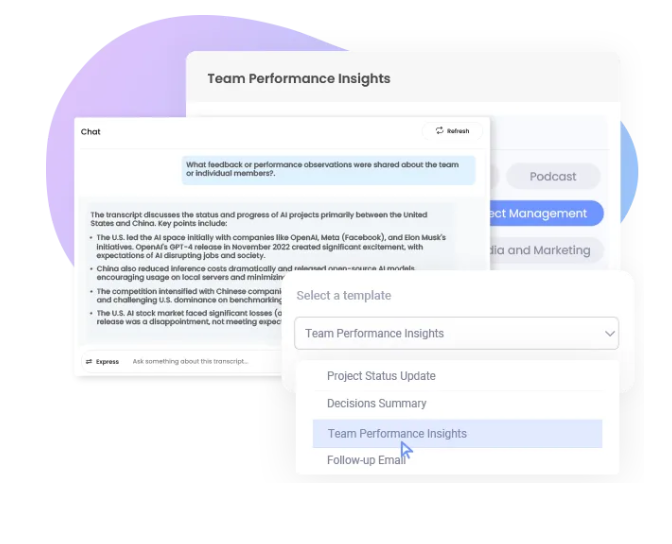
Instead of relying only on manual notes, AI can record and transcribe what was said during the meeting. This creates a written record that teams can search, review, and share.
Modern AI transcription services can help:
A recording is useful only if someone has time to watch or listen to it.
Most teams do not.
That is why searchability matters.
When meetings are transcribed, every conversation becomes part of a searchable knowledge base. Employees can look up past discussions, decisions, client requests, deadlines, and commitments without replaying long recordings.
For example:
Searchable meeting data reduces repetition and improves organizational memory.
Traditional notes usually capture what one person thought was important.
AI note taking can do more.
It can turn a transcript into structured outputs that help teams act faster after the meeting ends.
AI note taking can help generate:
This allows team members to stay focused during the actual conversation instead of trying to type everything in real time.
The difference is simple.
Traditional notes document parts of a meeting. AI note taking helps organize the meeting into useful next steps.
Also Read: How AI Notetakers and Business Transcription Services Save You Hours After Every Sales Call
Meetings are not just records of what happened.
They can reveal patterns.
When AI tools analyze meeting transcripts over time, businesses can start seeing what comes up again and again.
That may include:
This is where meeting data becomes intelligence.
A sales team can analyze customer objections across multiple calls. A product team can identify feature requests that keep appearing. Leadership can track strategic initiatives and see whether the same blockers keep slowing progress.
Different teams use meeting intelligence in different ways.
The value is not limited to one department.
Sales calls contain direct insight into what prospects want, what concerns them, and what may stop a deal from moving forward.
AI transcription services help sales teams:
Customer success teams need context before every client conversation.
Transcripts and AI note taking can help them:
HR conversations often require accurate documentation and careful follow-up.
AI meeting transcription can support:
Operations teams rely on clear ownership and process visibility.
Meeting intelligence can help them:
Many organizations already record meetings.
That is not enough.
Recordings create storage. Searchable transcripts create access.
A one-hour recording may contain valuable decisions, but if no one can quickly find them, that value stays locked away. Teams need the ability to search, filter, and review conversations without spending hours replaying meetings.
Searchable transcripts make it easier to:
The future of meetings will not be limited to recordings and summaries.
Meetings will become living knowledge repositories.
AI will help businesses track decisions, identify recurring themes, summarize progress, and connect conversations across teams. Over time, companies will be able to learn from meeting patterns instead of treating each call as a separate event.
AI-powered meeting intelligence may help businesses:
Businesses are adopting AI transcription services because they solve a real workflow problem.
Teams are creating more conversations than ever, but they do not always have a reliable way to organize what was said.
AI meeting transcription helps improve:
It reduces administrative work and helps teams focus on what matters after the meeting: action.
Meetings generate valuable business data every day.
Without the right tools, much of that data gets lost in recordings, scattered notes, or memory. AI meeting transcription and AI note taking help businesses preserve, organize, and analyze their conversations more effectively.
DictaAI helps turn meeting recordings into searchable transcripts, structured notes, action items, and useful business insights. That means every meeting can continue creating value long after the call ends.
Looking to make your meetings more useful?
Explore DictaAI’s Business plan to turn conversations into searchable intelligence, improve follow-ups, and help your team make better use of every discussion.

Comments
Glynnis Campbell
This is a test comment!