
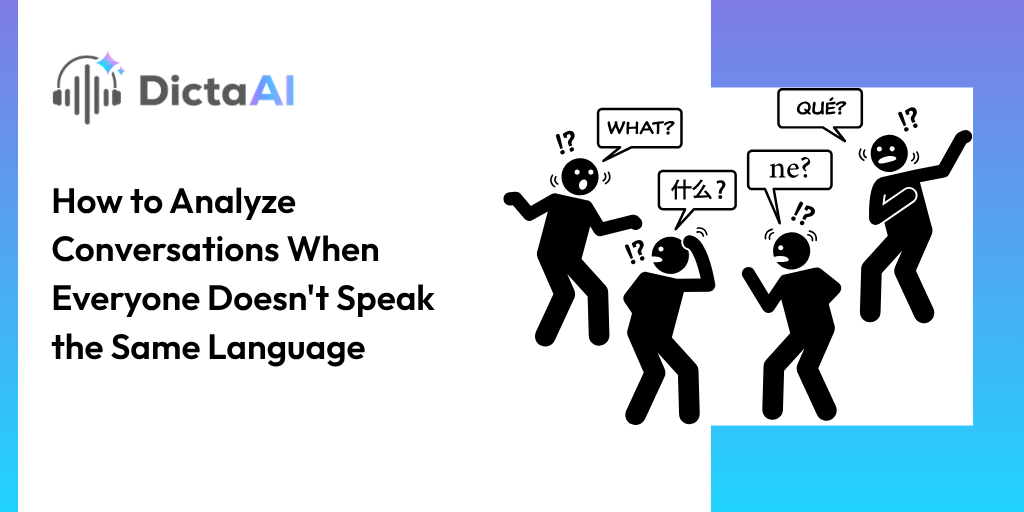
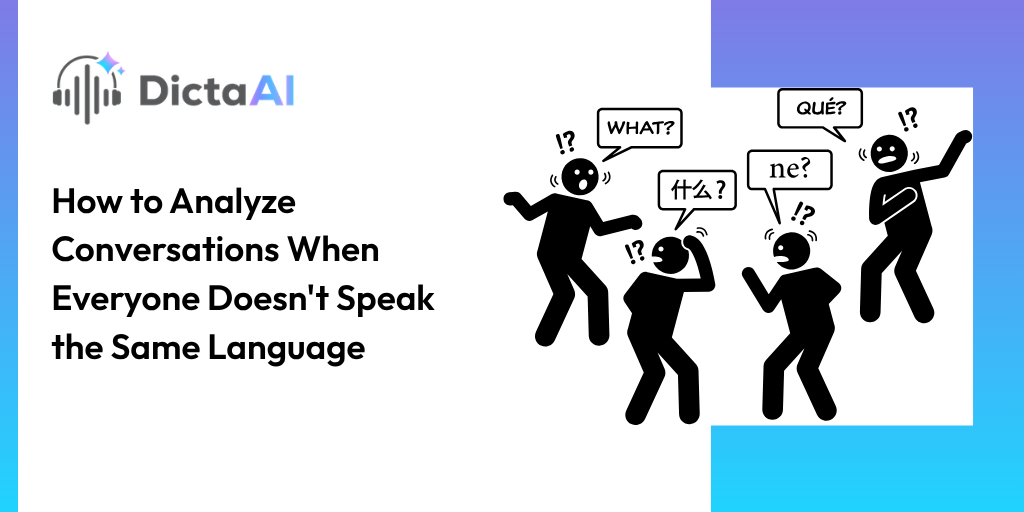
Ask a global research team to sum up an interview and you'll often get the answer in two languages, sometimes in the same sentence. A source in Mumbai code-switches between Hindi and English without noticing.
A focus group in Mexico City drifts into Spanglish halfway through. A cross-border team runs half the meeting in French, half in English, because that's just how the room talks. None of this is unusual. It's just genuinely hard to record, transcribe, and make sense of.
The recording part is easy. Multilingual transcription is where things get interesting, and it's only the first step in a workflow for turning multilingual audio into transcripts you can actually explore and analyze with AI.
Manually transcribing conversations across several languages usually means coordinating different translators or transcriptionists for each one. Translating everything before analysis adds a whole extra step, which adds time and cost before you've learned anything. On top of that, the same idea often gets expressed in very different words across languages, so a straightforward keyword search rarely finds what you're looking for. Once dozens of conversations are involved, comparing them by hand becomes impractical fast. This is where multilingual transcription paired with AI analysis starts to earn its place.
The workflow starts with uploading recorded interviews, meetings, calls, or other audio and video files to DictaAI to generate structured transcripts. Speaker separation distinguishes who said what, and timestamps let you trace any statement back to the exact moment it happened in the original recording. That searchable, structured transcript is the foundation everything else builds on.
Real conversations rarely stay in one language for their entire length. Multilingual speakers often move between languages naturally within the same sentence, not just between different meetings. Common examples include:
DictaAI supports mixed-language transcription for conversations where speakers switch between its supported languages, which matters for interviews, field research, customer conversations, and international teams where this kind of code-switching is the norm rather than the exception.
Producing accurate transcripts only solves the first part of the problem. A research project might include thirty interviews conducted across several languages. A multinational business could accumulate hundreds of conversations from different markets. Reading and comparing each one manually still takes a serious amount of time, even once every conversation has been transcribed.
This is where DictaLens comes in. Instead of opening transcripts one at a time, you can select multiple relevant files and use DictaLens's Multi-File Intelligence to analyze them together, asking questions across the whole set to surface recurring themes, decisions, similarities, and contradictions. A collection of multilingual transcripts stops being a stack of separate files and becomes a dataset you can actually question.
Also Read: Say Hello to DictaLens: Your AI Partner for Smarter Transcription Analysis
Exact keyword searches break down quickly in a multilingual dataset. A participant speaking Hindi and one speaking English might describe the same underlying problem without sharing a single search term, and a keyword search would treat them as unrelated. AI-based analysis works with meaning rather than exact wording, which makes it possible to ask broader questions across a set of transcripts instead of manually searching every file for specific phrases.
That flexibility is especially useful for comparison questions like:
These are the kinds of questions that matter when comparing customers, teams, or research participants from different markets or backgrounds, and they're difficult to answer by skimming transcripts one language at a time.
Conversations are often only part of a larger project. Researchers may also have field notes, questionnaires, or prior findings. Businesses may have project documentation or market reports sitting alongside the recordings. DictaLens supports analyzing uploaded PDFs alongside DictaAI transcripts, so that information can be investigated together instead of treated as two disconnected sources.
This kind of multilingual analysis shows up across several fields. Market researchers use it to compare interviews and focus groups involving participants from different markets. Academic and ethnographic researchers work across multilingual interviews and field recordings alongside their written research. International teams use it to capture and revisit conversations between globally distributed colleagues. Customer research teams compare feedback across regions, and journalists use it to organize and investigate recorded interviews involving multilingual sources.
The workflow itself stays consistent across all of these: record or upload the conversation, generate a searchable multilingual transcript, keep everything organized in one place, select the relevant files for a given question, and analyze them together with DictaLens, following up with additional questions as interesting findings come up.
Also Read: AI for Ethnographic Research: From Field Recordings to Research Insights
AI makes a large multilingual dataset dramatically easier to work through, but it does not replace human judgment. Language carries cultural references, ambiguity, humor, and specialist terminology that deserve a closer look before an important finding goes into a report or a decision. Timestamps and the original transcript make it easy to go back and check the source directly whenever something needs that kind of scrutiny.
Multilingual conversations should not have to become disconnected files that different people analyze separately. Bringing recording, multilingual transcription, and AI-powered analysis into a single workflow means teams spend less time processing conversations and more time understanding what those conversations actually reveal.
Upload your multilingual recordings to and start turning conversations across languages into transcripts and insights you can act on.
Can DictaAI transcribe conversations where people speak different languages?
Yes. DictaAI supports transcription across multiple languages, including the ability to work with conversations where different speakers use different languages.
Can DictaAI handle speakers switching between languages in the same conversation?
Yes. DictaAI supports mixed-language transcription for common code-switching patterns like Hinglish, Spanglish, and Franglais, which is useful for interviews and conversations where speakers naturally move between languages.
How can I analyze multiple multilingual transcripts together with DictaAI?
DictaLens lets you select multiple transcribed files and, where relevant, supporting PDFs, then ask questions across the whole set using Multi-File Intelligence instead of reading each transcript individually.
Can DictaLens identify common themes and patterns across multilingual conversations?
Yes. DictaLens is built to surface recurring themes, trends, and contradictions across a group of transcripts, working with the meaning of what was said rather than requiring an exact keyword match.
What types of multilingual conversations can I analyze with DictaAI?
Common use cases include market research interviews, academic and ethnographic research, international team meetings, customer research across regions, and journalism involving multilingual sources.
Comments
Glynnis Campbell
This is a test comment!