

Ethnographic research can reveal what surveys and dashboards often cannot: how people actually behave, what they struggle with, and how they describe their experiences in their own words.
The challenge starts after the fieldwork.
Hours of interviews, observations, and participant conversations can quickly turn into a mountain of recordings and transcripts. Finding the patterns across all of it takes time.
That is where AI for ethnographic research can help researchers move faster from raw conversations to the themes, contrasts, and insights that deserve closer attention, while keeping human interpretation at the center.
Ethnographic research often depends on depth rather than volume.
A single conversation may reveal important behaviors, motivations, concerns, or cultural context. However, when a project includes dozens of participants, the amount of qualitative data can quickly become difficult to manage.
Researchers may need to:
The challenge is not collecting information. It is finding meaning across many different sources.
Two participants may describe the same problem using completely different words. One may say a product feels “complicated,” while another says they “could not figure out the first step.” Both comments may point toward the same underlying experience.
This is where qualitative research analysis becomes more challenging as datasets grow.
Traditional ethnographic analysis relies heavily on researcher expertise, careful reading, and manual coding.
AI does not replace that process. Instead, it can support the parts that consume significant time.
For example, AI can help researchers:
The researcher remains responsible for interpretation, context, and final conclusions.
The value of AI is helping researchers move faster from raw information to areas that deserve closer attention.
Also Read: Market Research Transcription in 2026: How AI Is Changing Qualitative Analysis
Before analysis can happen, spoken conversations need to become usable data.
This is where interview transcription becomes an important part of the research workflow.
Field recordings often include:
AI transcription can convert these recordings into searchable text, making it easier to locate specific comments without repeatedly listening to entire recordings.
A useful transcript should make it easier to:
For researchers working across multiple interviews, searchable transcripts create a much stronger foundation for AI qualitative data analysis.
Also Read: How to Capture High-Quality Interviews Using Just Your Smartphone
A single interview can contain valuable information, but finding those insights manually can still take time.
With AI interview analysis, researchers can examine individual transcripts to understand:
For example, after an interview, a researcher may ask:
This creates a faster first layer of analysis while allowing researchers to return to the original transcript for deeper interpretation.
The bigger advantage appears when multiple interviews are analyzed together.
Ethnographic insights rarely come from one participant. They emerge from patterns across many conversations.
With multi-file analysis, researchers can examine several transcripts as one research dataset and explore questions such as:
This is where thematic analysis becomes more scalable.
Instead of manually comparing dozens of transcripts, researchers can use AI to identify patterns worth investigating and then validate those findings against the original conversations.
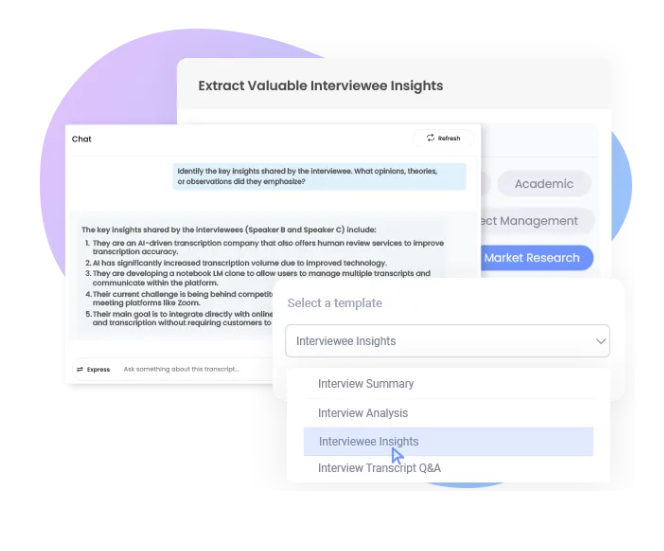
DictaLens, DictaAI’s analysis workspace, helps researchers move beyond storing transcripts.
Researchers can analyze individual transcripts, compare multiple files, and combine interview data with supporting documents.
For example, a research project may include:
By bringing these sources together, researchers can ask broader questions and explore connections between conversations and supporting information.
Useful research workflows include:
Identify recurring themes, concerns, behaviors, and opportunities across multiple interviews.
Create structured views of participant experiences, attitudes, needs, and pain points.
Compare how different participants respond to similar research questions.
These outputs help researchers locate patterns faster while keeping human interpretation at the center.
One of the most time-consuming parts of qualitative research is identifying themes.
Researchers often need to read multiple transcripts, code responses, compare observations, and determine which ideas appear consistently.
AI can assist by identifying:
For example, across 20 interviews, AI may help identify that several participants mention difficulty with onboarding, even though they describe the problem differently.
The important next step is validation.
A theme is not automatically meaningful just because it appears several times. Researchers still need to examine context, participant background, and the original conversation.
Ethnographic research rarely exists in isolation.
Researchers often work with additional materials that provide important context.
Combining transcripts with documents can help connect:
This creates a more complete view of the research project without requiring researchers to switch between multiple disconnected sources.
A simple workflow looks like this:
1. Capture field conversations
Record interviews, discussions, or research sessions with appropriate consent.
2. Generate transcripts
Convert recordings into searchable text.
3. Organize research files
Group interviews and add supporting documents where needed.
4. Analyze individual and multiple files
Explore participant insights, themes, patterns, and comparisons.
5. Ask research questions
Investigate specific topics across the dataset.
6. Validate findings
Return to original transcripts and confirm important observations.
7. Build research insights
Use validated findings for reports, recommendations, and decisions.
| Research Task | Traditional Approach | AI-Assisted Approach |
|---|---|---|
| Transcription | Manual processing | Faster transcript generation |
| Finding comments | Search recordings manually | Search transcripts quickly |
| Theme discovery | Manual coding and comparison | AI-assisted pattern discovery |
| Comparing participants | Review multiple files separately | Analyze multiple interviews together |
| Finding contradictions | Revisit transcripts manually | Ask targeted questions across data |
| Final interpretation | Researcher-led | Researcher-led |
The strongest workflow is not AI instead of researchers.
It is AI supporting researchers.
Ethnographic research depends on understanding context.
A transcript may capture words, but it may not fully represent:
AI can highlight patterns, but researchers determine what those patterns mean.
Important findings should always be checked against original recordings and transcripts.
Ethnographic research produces rich, detailed information, but the real value comes from seeing what those conversations reveal when viewed together.
DictaAI helps researchers turn field recordings into searchable transcripts, while DictaLens makes it easier to compare interviews, explore recurring themes, and investigate patterns across qualitative data.
That means less time sorting through hours of material and more time focusing on the context, behaviors, and experiences that shape meaningful research findings.
Try DictaAI for a faster, more focused qualitative research workflow.
How can AI be used in ethnographic research?
AI can help researchers transcribe field recordings, analyze interviews, compare participant responses, identify themes, and organize qualitative data for deeper review.
Can AI analyze multiple ethnographic interviews at once?
Yes. Multi-file analysis allows researchers to examine multiple transcripts together and identify recurring themes, shared experiences, differences, and patterns across participants.
Can AI identify themes across qualitative research interviews?
AI can help surface repeated ideas and related concepts across interviews. Researchers should review the original transcripts to validate those themes and understand their context.
How can AI help with ethnographic interview transcription and analysis?
AI can convert field recordings into searchable transcripts and help researchers analyze participant experiences, responses, and recurring patterns more efficiently.
Can AI replace manual qualitative data analysis?
No. AI can accelerate searching, comparison, and pattern discovery, but researchers remain responsible for interpretation, methodology, and final conclusions.




Comments
Glynnis Campbell
This is a test comment!