

Businesses are not short on information. They are short on time to make sense of it.
Reports, PDFs, meeting transcripts, interviews, and recorded conversations often hold valuable insights, but connecting them manually can take hours.
AI document analysis helps users summarize, compare, question, and identify patterns across that information faster. And once conversations are transcribed, the same workflow can extend into transcription analysis, AI speech analytics, and conversation intelligence, turning scattered content into something teams can actually use.
Think of document search and document analysis as two different jobs.
Search helps you find a word or phrase you already know you need. AI analysis can help you investigate a broader question.
For example, instead of searching 12 customer interviews for the word "onboarding," you might ask:
"What onboarding problems appear repeatedly across these interviews?"
The AI can examine the available content and surface relevant themes, similarities, differences, or supporting information.
Depending on the platform and source material, AI document analysis can help:
This is also where AI data analytics is expanding beyond spreadsheets and numerical datasets. Meetings, interviews, reports, and other text-heavy sources contain data too. The challenge is making that unstructured information easier to analyze.
The workflow is simpler than it sounds.
1. Add the source material
Upload the documents, transcripts, or other supported files you want to investigate.
2. Let AI process the content
The system examines the text and context so the information can be queried and analyzed.
3. Define what you want to know
Ask a question or choose a specific type of analysis.
4. Analyze the relevant information
The AI examines the available source material for information connected to your request.
5. Review the findings
Depending on the question, the output could include a summary, comparison, themes, patterns, or specific answers.
6. Dig deeper
Instead of beginning again, you can ask follow-up questions and investigate interesting findings further.
The real advantage is not simply reading a document faster. It is being able to interact with information rather than repeatedly hunting through files.
Manual review still matters, especially when interpretation and context are important. But AI can dramatically reduce the time spent locating the evidence worth reviewing.
| Task | Traditional Review | AI Document Analysis |
|---|---|---|
| Read long documents | Manual | AI-assisted |
| Find exact keywords | Yes | Yes |
| Summarize content | Manual | Automated |
| Ask questions about content | Manual investigation | Natural-language queries |
| Identify recurring themes | Manual comparison | AI-assisted |
| Compare multiple files | File-by-file | Cross-file analysis |
| Scale to larger datasets | Time-intensive | Faster to explore |
The distinction matters. AI is not replacing the person responsible for interpreting the findings. It can reduce the manual search and comparison work that happens before that interpretation.
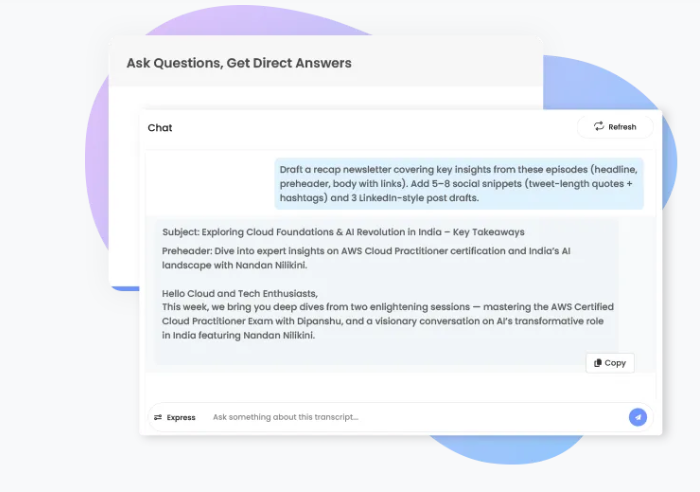
Some of the most valuable business information never begins in a PDF.
It happens during:
A recording preserves the conversation, but it does not necessarily make the information easy to use.
Once speech becomes a searchable transcript, however, that conversation can enter the same analysis workflow as written content.
The process becomes:
Conversation → Transcription → Analysis → Insight
This is the idea behind transcription analysis. Instead of treating speech-to-text as the final output, teams analyze the resulting transcript to understand decisions, questions, concerns, themes, action items, and recurring issues.
Analyzing one conversation can answer, "What happened?"
Analyzing many conversations can answer much more interesting questions.
For example:
This broader use of AI speech analytics helps turn recorded speech into information that can be examined rather than simply replayed.
Conversation intelligence takes that idea further by looking at what conversations collectively reveal.
Imagine reviewing 20 customer interviews. One interview may contain an interesting complaint. If the same issue appears in 12 interviews, however, it may signal a pattern worth investigating.
That distinction between an individual comment and a recurring pattern is where multi-file analysis becomes particularly useful.
Also Read: How DictaAI Turns Meeting Conversations into Searchable Business Intelligence
Not every task requires analyzing an entire library.
Single-file analysis works well when you want to understand one source deeply:
"What were the main concerns raised during this customer interview?"
It can also help summarize one report, examine one meeting, or answer detailed questions about a specific transcript.
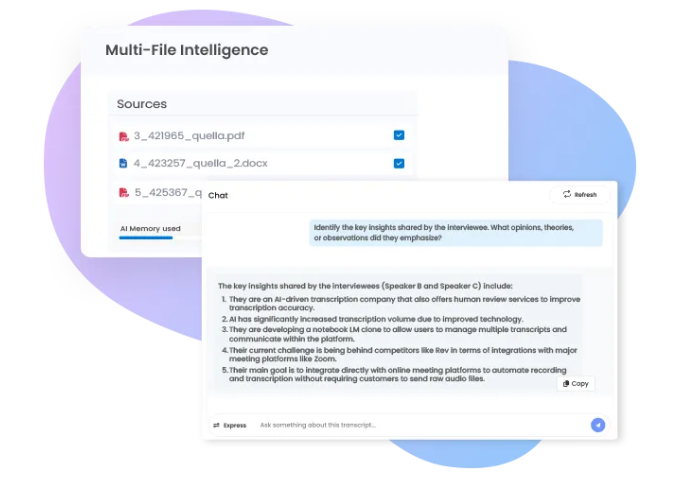
Multi-file analysis becomes useful when the question depends on comparison:
"What concerns appear repeatedly across these 15 customer interviews?"
Now you are looking for patterns, differences, recurring themes, and relationships across sources.
For market researchers, that could mean comparing participant perspectives. For business teams, it could mean tracking issues across several meetings. For customer teams, it could reveal frequently mentioned requests that are easy to overlook when calls are reviewed individually.
This is where document analysis becomes considerably more useful.
A project rarely exists inside one type of file. Market research may include interview transcripts plus a research brief. A client project may involve meetings plus reports. Training may combine recorded sessions with manuals and supporting materials.
Analyzing those sources together can provide richer context than examining each one separately.
For example:
Market research interviews + research brief
Compare participant responses against the original research objectives.
Client meetings + project documents
Examine whether conversations align with documented requirements or plans.
Training transcripts + training materials
Compare what was discussed with the material participants were given.
This is a practical form of AI data analytics for information that would otherwise remain fragmented across files.
DictaAI's approach is built around the idea that transcription should not be where the workflow ends.
With DictaLens, users can analyze individual transcripts or work across multiple files. The workspace can bring DictaAI transcripts, externally created transcripts, and PDFs into the analysis process. Users can then ask questions, compare information, explore themes, and investigate relationships across the available material.
That creates a useful progression:
Record or Upload → Transcribe → Analyze → Compare → Explore
For example, a researcher could analyze a single participant interview first, then bring multiple interviews together to look for recurring themes. Supporting PDFs could then provide additional project context.
The value is not simply generating another AI summary. It is making different pieces of information easier to investigate together.
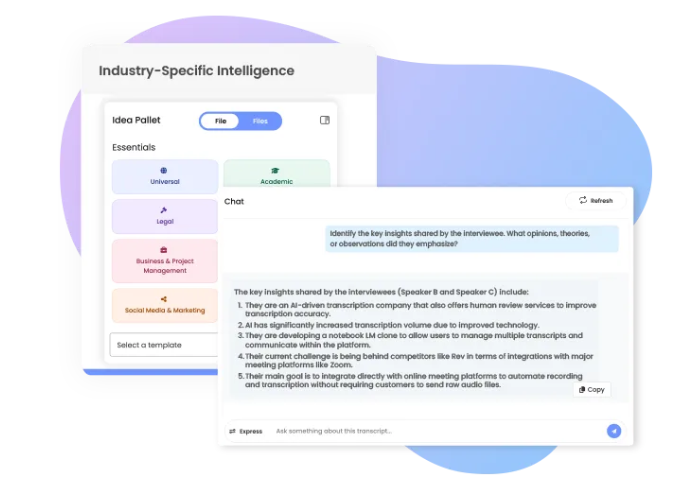
The same workflow can solve very different problems depending on the team using it.
Market research: Analyze interview transcripts, compare participants, and surface recurring pain points or themes.
Business meetings: Revisit decisions, identify action items, and investigate recurring issues across multiple discussions.
Customer research: Examine feedback across conversations to identify repeated requests, concerns, and customer perspectives.
Education and training: Analyze lectures or training transcripts alongside supporting PDFs and course materials.
Media: Explore interviews, podcasts, and recorded discussions without repeatedly scrubbing through hours of audio.
In each case, the technology handles more of the locating, organizing, and comparing. People still decide what the findings actually mean.
AI can make a 100-page review faster. That does not automatically make every conclusion correct.
The quality of the analysis depends heavily on the source material. If a transcript misidentifies an important technical term, the analysis is working from imperfect information. Poor audio can create transcription errors before analysis even begins.
AI can also miss nuance, context, humor, or the significance of an unusual response.
A sensible workflow is therefore:
Use AI to find → use humans to interpret → return to the source to verify.
That matters especially for research conclusions, legal information, important business decisions, direct quotations, and other high-stakes uses.
AI works best here as an analysis assistant, not as the final authority.
The value of AI document analysis is not in collecting more information. It is in making the information you already have easier to understand, compare, and use.
DictaAI brings documents and conversations into the same workflow, while DictaLens helps teams analyze transcripts and supporting files, compare multiple sources, and surface the insights that matter.
Explore DictaAI to turn documents, transcripts, and conversations into searchable, actionable knowledge.
What is AI document analysis and how does it work?
AI document analysis uses artificial intelligence to examine written content and help users summarize, extract, compare, question, and identify patterns within it. Users provide source files and then ask questions or select analyses based on what they want to understand.
Can AI analyze multiple documents at the same time?
Yes, platforms with multi-file analysis can examine several supported files together. This is useful for comparing documents, finding recurring themes, identifying differences, and exploring patterns across a larger dataset.
What is the difference between AI document analysis and AI data analytics?
AI document analysis focuses specifically on extracting meaning from documents and other text-based information. AI data analytics is a broader category that can include numerical, structured, and unstructured data analysis.
Can AI analyze meeting and interview transcripts?
Yes. Once a meeting or interview has been transcribed, AI can help summarize it, answer questions, identify themes, extract decisions or action items, and compare information across multiple transcripts.
How does AI speech analytics turn conversations into actionable insights?
AI speech analytics uses recorded conversations and their transcripts to identify useful information such as recurring topics, concerns, decisions, questions, or patterns. Human review remains important when those findings will inform significant decisions.

Comments
Glynnis Campbell
This is a test comment!