

You spend hours planning, recording, and editing your podcast. The insights are strong. The conversations are valuable. Your audience loves it.
But Google has no idea what you said.
Search engines cannot listen to audio. If your episode only exists as a sound file, most of its value stays hidden. That is why smart creators now transcribe podcasts to text and publish podcast transcripts alongside each episode. Turning audio into searchable content makes your podcast discoverable, indexable, and far more powerful for SEO. With AI-powered tools like DictaAI, converting episodes from audio to optimized text is fast, simple, and scalable.
Google and other search engines rely on text to understand and rank content. They cannot crawl spoken words inside an MP3 file.
Without podcast transcripts:
Even if your episode contains strong insights and relevant keywords, none of that matters if search engines cannot read it.
Podcast transcription is the process of converting spoken audio into written text. It creates a full written record of your episode that can be published on your website.
There are two main approaches:
Manual transcription: This involves typing out audio word for word. While accurate, it is slow, expensive, and difficult to scale.
AI-powered transcription: Modern AI transcription services automatically convert audio into structured text within minutes. This approach is faster, more cost-effective, and ideal for ongoing content production.
DictaAI provides AI-powered podcast transcription that allows creators to transcribe podcasts to text efficiently while maintaining high accuracy and clean formatting.

There are several benefits of podcast transcription in SEO:
When you publish podcast transcripts, search engines can index the full content of your episode. This allows your site to rank for:
More indexed content means more ranking opportunities. Instead of one episode page with minimal text, you now have long-form, keyword-rich content that search engines can understand.
Transcripts help you capture users searching for specific questions or topics mentioned during your episode. Long-form text increases your chances of appearing in:
Each episode becomes a traffic asset rather than just an audio file.
Audio alone cannot be optimized. Text can.
Podcast transcripts allow you to naturally include target keywords within headings, summaries, and formatted sections. This improves keyword density without forcing unnatural phrasing.
You can optimize for:
Over time, this builds topical authority and strengthens your SEO strategy.
Not everyone wants to listen to a full 45-minute episode.
Some users prefer to skim, scan, or jump to specific sections. Podcast transcripts support different content consumption styles and improve:
This engagement sends positive signals to search engines.
Transcribing podcasts also improves accessibility. Written content helps:
Accessibility improvements often align with better SEO performance because they enhance overall user experience.
When you convert audio into text, you unlock another layer of value. Transcripts can be analyzed using a podcast analytics tool.
With text-based analysis, you can identify:
DictaAI acts as both a transcription engine and a podcast analytics tool. Once your episode is transcribed, you can search across transcripts, extract themes, and generate insights that inform future content strategy.
One of the biggest benefits of podcast transcription is content repurposing.
A single transcript can be turned into:
This extends the lifecycle of each episode and improves return on investment. Rather than producing one piece of audio content, you create multiple written assets that continue generating traffic and engagement.
Also Read: Transforming Podcasts into Blogs with AI Transcription: Expanding Your Reach and Engagement
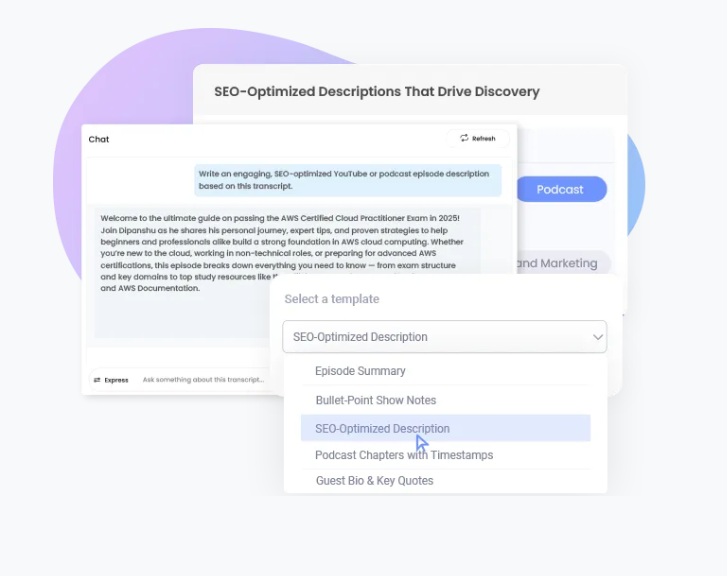
If you publish regularly, transcription needs to be fast, accurate, and scalable. DictaAI is built to help you transcribe podcasts to text efficiently while turning every episode into a searchable asset.
With DictaAI, you get:
Instead of relying on basic audio to text services, you gain structured content that can be analyzed, summarized, and repurposed. DictaAI helps you move from transcription to strategy, making every episode work harder for your growth.
Simply publishing raw text is not enough. To maximize SEO value:
Many creators undermine their SEO efforts by:
Podcasts are powerful, but audio alone keeps most of your content invisible to search engines. When you transcribe podcasts to text, you turn every episode into searchable, indexable content that drives SEO, improves accessibility, supports analytics, and extends your content reach.
Podcast transcription is no longer optional for creators who want sustainable growth. It is a competitive advantage.
If you are serious about increasing organic traffic and maximizing the impact of every episode, publishing podcast transcripts should be part of your standard workflow. DictaAI makes it easy to transcribe podcasts to text at scale, analyze your content, and convert conversations into measurable growth.
Start treating your podcast as a search asset, not just an audio file.
It means converting spoken podcast audio into written text so it can be published, indexed, and optimized for search engines.
Podcast transcripts provide crawlable content that search engines can index, helping episodes rank for relevant keywords and long-tail searches.
AI transcription services like DictaAI provide fast and scalable podcast transcription with built-in analytics capabilities.
Yes. Transcripts increase keyword visibility, improve search rankings, and attract organic traffic from users searching for specific topics.
By analyzing transcript text, DictaAI can identify recurring themes, keyword trends, and audience interests to inform future content strategy.




Comments
Glynnis Campbell
This is a test comment!