

Ten hours of interviews can quickly turn into hundreds of transcript pages.
The real challenge is not transcription. It is figuring out what the interviews are collectively telling you. Which pain points repeat? Where do participants disagree? Which responses stand out? What patterns are easy to miss when each transcript is reviewed separately?
AI interview analysis helps researchers examine multiple interviews together, surface the themes worth investigating, and return to the right source conversations for validation.
That means less time hunting through transcripts and more time interpreting the insights that matter.
One interview is manageable.
Twenty interviews are a different story.
Important findings rarely appear in exactly the same language. One customer might describe a product as “too complicated,” another may say onboarding took too long, while someone else says they could not figure out where to start.
Those comments may point toward the same underlying friction, even though the participants never use the same words.
As the dataset grows, researchers have to:
Traditional qualitative research analysis still requires human interpretation. What changes with AI is how quickly researchers can find the parts of the dataset that deserve that attention.
Also Read: How to Use AI Transcription for Qualitative Research: Simplify Data Analysis for Market Researchers
Not necessarily.
Detailed transcript reading remains important when context, nuance, language, or participant behavior needs close interpretation. But researchers do not always have to read every transcript from beginning to end before they can start identifying patterns.
AI can provide a first analytical pass across the dataset.
For example, instead of manually reading 15 interviews looking for pricing concerns, a researcher could ask:
The results give the researcher somewhere useful to start.
They can then return to the relevant transcripts, examine the participant's full response, check the surrounding conversation, and determine whether the apparent pattern holds up.
That distinction matters.
AI can narrow the search. The researcher still interprets the evidence.
The real advantage appears when interviews are analyzed together rather than one file at a time.
With multi-file analysis, researchers can treat a collection of transcripts more like a connected research dataset.
AI can help surface:
This can make the early stages of thematic analysis of interview transcripts much faster.
Imagine conducting 20 customer interviews about a new software product. Instead of opening every transcript and searching separately for reactions to onboarding, you could investigate the question across all 20 interviews.
You might ask:
What difficulties did participants repeatedly mention during onboarding?
Then go deeper:
Which participants did not experience these difficulties?
Or:
What differences appear between positive and negative onboarding experiences?
That changes interview analysis from sequential reading into active exploration of the dataset.
Also Read: How to Capture High-Quality Interviews Using Just Your Smartphone
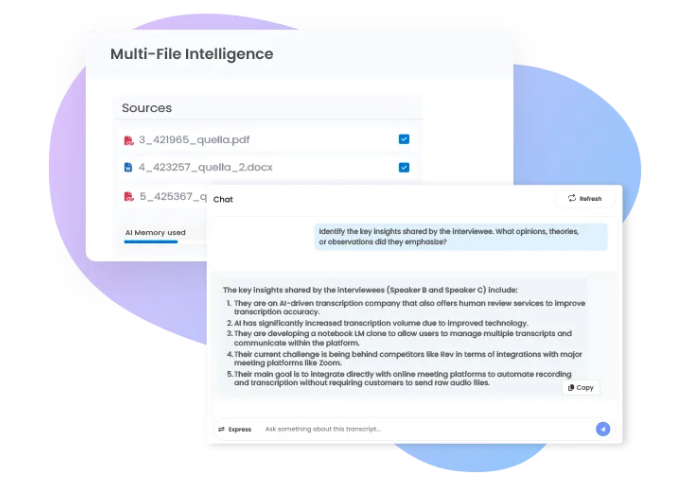
DictaLens, DictaAI's analysis workspace, supports both single-file and multi-file analysis.
Researchers can analyze several interview transcripts together to look for themes, patterns, trends, participant differences, and other cross-file insights.
The workflow is not limited to interviews transcribed through DictaAI. Existing transcripts can also be imported for analysis.
Researchers can also add relevant PDFs alongside interview transcripts. That could include:
This becomes useful when the research question depends on more than what participants said.
Instead of repeatedly moving between transcripts, project documents, and notes, researchers can bring relevant material into the same analysis workflow and ask questions across multiple sources.
DictaLens includes multi-file prompts that can help researchers approach large interview datasets from different angles.
Interview Insights and Action Plan
Useful for identifying recurring insights, needs, concerns, and potential opportunities across several interviews, then organizing those findings into possible next steps.
Participant Insight Snapshot
Useful when the research requires a clearer picture of individual perspectives. Researchers can examine needs, attitudes, behaviors, and pain points, then compare where participants align or differ.
Interview Q&A Digest
Useful for structured or semi-structured interviews where the same core questions were asked repeatedly. It helps consolidate responses so researchers can compare areas of agreement and disagreement more efficiently.
These outputs should not automatically become the final research conclusions. They provide a faster way to locate patterns that deserve closer examination.
You do not need a complicated AI research process.
A practical workflow can look like this:
1. Transcribe or Import the Interviews
Convert the interview recordings into transcripts or import transcripts that already exist.
2. Organize the Research Dataset
Group the interviews connected to the same project, research question, audience, or study.
3. Add Supporting Context
Include relevant PDFs when a research brief, background document, or previous report would help provide context.
4. Analyze Multiple Files Together
Select the relevant transcripts in DictaLens and begin with a multi-file research prompt.
5. Ask Follow-Up Questions
This is where the analysis becomes more useful.
Move beyond broad questions such as:
What are the main themes?
Ask more specific questions:
Which concerns appeared in at least several interviews?
Where did participants disagree?
What feature requests appeared repeatedly?
Which responses contradict the dominant pattern?
What differences appear between participant groups?
6. Validate Against the Source
Once AI surfaces an interesting pattern, return to the relevant transcripts.
Read the original statements in context. Check whether the interpretation accurately represents what participants meant. Look for exceptions and contradictory evidence.
Validated findings can then support deeper analysis, reporting, and recommendations.
AI does not remove the need for qualitative expertise. It changes where researchers spend their time.
| Research Task | Manual Transcript Review | AI-Assisted Analysis |
|---|---|---|
| Initial exploration | Read transcripts individually | Examine multiple transcripts together |
| Theme discovery | Highlight and compare manually | Surface recurring ideas for investigation |
| Participant comparison | Cross-reference notes and transcripts | Compare responses across files |
| Finding contradictions | Requires rereading and cross-checking | Ask directly for opposing viewpoints |
| Specific questions | Search interviews individually | Query the dataset |
| Follow-up analysis | Revisit multiple documents | Ask progressively deeper questions |
| Final interpretation | Researcher required | Researcher still required |
The biggest benefit is not eliminating human analysis.
It is reducing the repetitive searching and cross-referencing that happens before deeper analysis can begin.
AI for market research works best as an analytical assistant, not an autonomous researcher.
It can surface patterns, summarize participant perspectives, compare interviews, and point researchers toward interesting sections of a large dataset.
It cannot independently determine whether a pattern is meaningful within the full research context.
Researchers still need to consider:
A frequently mentioned idea is not automatically an important insight. An outlier comment is not automatically irrelevant either.
That judgment belongs to the researcher.
For high-impact findings, the safest workflow is straightforward: use AI to find, compare, and organize; use the original source material and researcher expertise to validate and interpret.
Ten hours of interviews should not mean ten hours of searching transcripts before meaningful analysis can even begin.
AI interview analysis can help researchers examine conversations collectively, find recurring themes, compare participants, investigate contradictions, and quickly locate the evidence behind potential insights.
DictaLens brings those capabilities into a multi-file workspace where researchers can analyze interview transcripts alongside relevant supporting documents and continue asking questions as the research develops.
The result is not research without human analysis. It is a faster route to the parts of the dataset that deserve human attention.
Explore DictaAI's Multi-File Analysis to turn hours of interview data into research you can investigate, validate, and act on.
Can AI analyze multiple interview transcripts at once?
Yes. Multi-file AI analysis can examine several transcripts together, helping researchers identify recurring themes, participant differences, shared concerns, contradictions, and other patterns across the dataset.
Can AI identify recurring themes across qualitative interviews?
AI can surface repeated ideas and related concepts across multiple interviews, even when participants describe similar experiences differently. Researchers should then review the relevant source material to validate those themes and interpret their significance.
Can DictaLens analyze transcripts created outside DictaAI?
Yes. The provided DictaLens workflow supports importing existing transcripts for analysis, so researchers are not limited to interviews originally transcribed through DictaAI.


Comments
Glynnis Campbell
This is a test comment!