

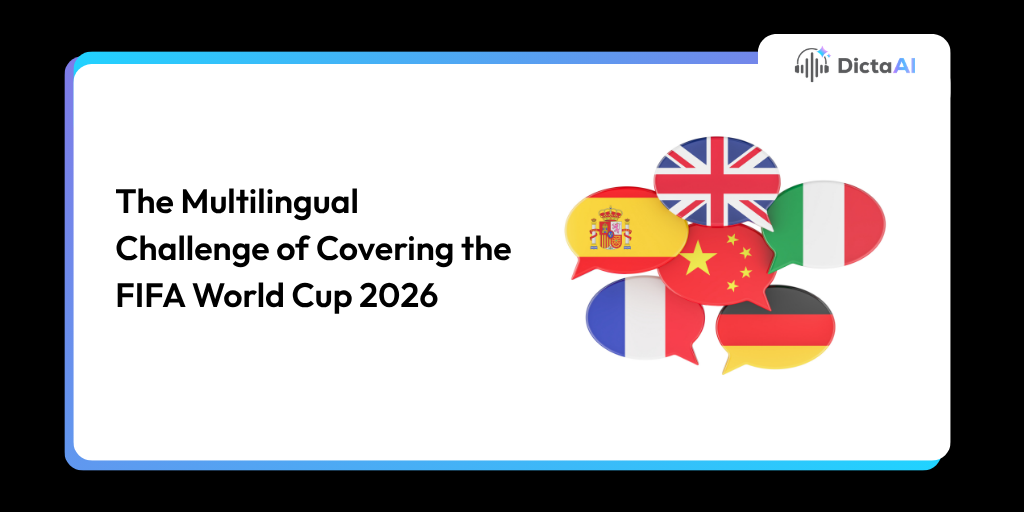
FIFA World Cup 2026 is a global media marathon, not just a tournament. Reporters, broadcasters, podcasters, and creators will cover interviews, press conferences, fan reactions, match analysis, and multilingual conversations from teams around the world.
The real challenge is turning all that audio and video into accurate, usable content fast. AI transcription services like DictaAI help media teams convert multilingual recordings into searchable, editable text while keeping human review in the workflow.
World Cup coverage often involves people speaking across different languages in fast-moving environments.
A single press conference may include a question in one language, an answer in another, an interpreter translating between speakers, and follow-up questions from reporters across the world. A player may also switch languages mid-answer depending on the audience or emotion of the moment.
That creates real pressure for journalists and editors.
They need accurate quotes, clear context, fast summaries, and publishable content while the story is still fresh. When recordings include unfamiliar names, accents, interpreters, background noise, and football-specific language, manual processing becomes slow and difficult.
This is why media transcription services are becoming more useful for global sports coverage.
Language barriers can delay reporting at the exact moment speed matters most.
A journalist may need to replay a recording several times, check a quote with a translator, verify names, manually type responses, and rewrite the content for a different audience.
During the World Cup, those delays can affect breaking-news coverage, match reactions, and post-match analysis. A quote that matters immediately after a game may lose impact if it takes hours to process.
Audio transcription for media gives journalists a stronger starting point. Instead of working from a long audio file or scattered notes, they can begin with a written transcript that is easier to search, review, and organize.
Also Read: DictaAI Now Supports Spanglish, Franglais, Hinglish & Hebrew Transcription
Even when speakers use the same language, transcription can still be challenging.
A coach may speak quickly after a tense match. A player may use informal expressions or football slang. A journalist may ask questions in a crowded mixed zone. Fans may be cheering in the background.
Common challenges include:
Code-switching means moving between two or more languages within the same conversation.
This can happen often during international sports coverage. A player may answer in English, switch to Spanish for a phrase, and then return to English. A broadcaster may speak to both local and global audiences. Fans may naturally mix languages in reaction videos.
Examples may include English-Spanish, English-French, Spanglish, Hinglish, or Franglais-style conversations.
Traditional single-language transcription workflows can struggle with this. Mixed-language speech may be harder to capture, organize, and reuse.
DictaAI supports multiple languages and selected mixed-language speech formats, helping teams create a more usable transcript from complex multilingual recordings. That gives journalists and creators a better first draft to review and refine.
Player interviews and press conferences often produce the biggest headlines of the tournament.
They include comments on tactics, player fitness, team selection, match performance, and tournament expectations. Instead of replaying recordings repeatedly, journalists can work from searchable transcripts to quickly find important quotes and organize their stories.
Speaker labels also make it easier to separate journalists' questions, players' responses, interpreter translations, and follow-up comments.
Even with AI-generated transcripts, direct quotes should always be reviewed before publication.
World Cup coverage goes far beyond traditional news.
Podcasts, YouTube channels, fan shows, and independent creators will publish content almost every day, often featuring multilingual guests and discussions.
Media transcription services help turn those recordings into:
Transcription and translation serve different purposes, but together they create a faster publishing workflow.
A typical process looks like this:
A reliable transcript provides the foundation for reaching audiences across multiple languages.
Transcripts make World Cup coverage easier to access for everyone.
They support audiences who are deaf or hard of hearing, prefer reading, cannot play audio, or are not fluent in the speaker's language. They also provide a strong foundation for captions and future translations.
From an SEO perspective, transcripts give search engines text they can index. That makes interviews, podcasts, press conferences, and match discussions easier to discover through search.
By the end of the tournament, media teams may have hundreds of recordings.
Searchable transcripts make it much easier to find a specific player quote, coach comment, or press conference without replaying hours of audio.
Organizing transcripts by player, team, match, language, or date also helps journalists reconnect earlier comments with new tournament storylines.
Better recordings lead to better transcripts.
A few simple practices can improve accuracy:
Also Read: How AI Transcription Is Transforming FIFA World Cup 2026 Media Coverage
Language is shaped by context, tone, emotion, and culture.
A phrase can carry different meanings depending on the speaker or situation, and a small transcription or translation mistake can quickly become a major story during a global tournament.
AI can dramatically speed up transcription, but human editors should always verify names, quotations, technical terms, and sensitive statements before publication.
Multilingual communication will be one of the defining challenges of FIFA World Cup 2026 media coverage.
Accents, language switching, interpreters, background noise, and tight deadlines can make sports reporting more complex. AI transcription services help media teams turn diverse audio and video recordings into searchable text that is easier to review, edit, translate, and repurpose.
DictaAI’s media transcription services can support interviews, press conferences, podcasts, localization, accessibility, SEO, and content repurposing across the tournament.
Reliable audio transcription for media, combined with careful human review, can help publishers cover more stories, move faster, and serve a truly international audience.
AI transcription services give journalists a written version of recorded interviews, making it easier to locate quotes, organize responses, verify names, and prepare content faster.
DictaAI can help process recordings with different accents, multiple speakers, and selected mixed-language speech formats. Human review is still recommended for poor audio, overlapping speakers, or publishable direct quotes.
Audio transcription for media gives teams a written foundation they can use to create articles, summaries, captions, newsletters, social posts, and localized content for different audiences.
Yes. AI-generated transcripts should be reviewed before publishing direct quotes, translated statements, sensitive comments, or specialized names to ensure accuracy and proper context.


Comments
Glynnis Campbell
This is a test comment!