
India doesn’t speak in straight lines.
Walk into a boardroom meeting in Mumbai, listen to a startup pitch in Bengaluru, or join a sales call in Delhi. You won’t hear pure English. You won’t hear pure Hindi either. You’ll hear something in between.
“Client ne timeline prepone kar diya, but we can adjust if team coordinate kar le.”
This blend isn’t accidental. It’s natural. It’s efficient. It’s how modern India communicates.
Yet most AI transcription services are built for single-language conversations. They expect clean English or clean Hindi. When faced with mixed-language speech, they struggle. Words get misinterpreted. Context gets lost. Sentences break mid-thought.
That’s where Hinglish transcription becomes the missing link.
Hinglish transcription is not about translating Hindi into English or English into Hindi. It’s about accurately converting mixed Hindi-English speech into readable, context-aware text.
When someone says, “Deck final ho gaya, but numbers thoda revise karna hai,” a strong AI transcription tool understands the entire sentence as one cohesive idea. It doesn’t stumble over “ho gaya” or misinterpret “revise karna.” It captures the natural rhythm of how the sentence was spoken.
More importantly, it preserves intent.
This difference might seem small, but in business settings, it changes everything. A transcript isn’t just a record. It’s documentation. It’s accountability. It’s insight.
Most AI transcription software has been trained primarily on monolingual data. That means it performs well when conversations stay neatly within one language. India rarely does that.
An English-only AI transcription tool may mishear Hindi words as English sounds. A Hindi-only system may freeze when business jargon appears mid-sentence. The result is messy output that feels unreliable.
Incorrect transcripts lead to confusion. Key decisions can be misrecorded. Important context disappears. Teams waste time correcting errors manually.
When businesses rely on AI transcription services for compliance, internal reviews, sales tracking, or documentation, accuracy cannot be optional.
India’s communication style demands something more adaptive.
Hinglish is no longer informal speech used only in casual conversations. It dominates professional environments.
Sales teams pitch in Hinglish. Customer support agents respond in Hinglish. Startup founders brainstorm in Hinglish. Internal performance reviews often blend languages seamlessly.
It reflects comfort, speed, and cultural familiarity.
As more Indian businesses adopt AI transcription tools for meetings, call reviews, and reporting, the gap becomes obvious. If the tool doesn’t understand how the team speaks, it cannot generate reliable transcripts.
Accurate Hinglish speech-to-text is no longer a niche requirement. It is becoming essential for Indian workflows.
Hinglish transcription bridges three critical gaps in traditional AI transcription systems.
First, it closes the language gap by understanding Hindi and English together rather than separately. Second, it captures cultural context, recognizing how intent is expressed in mixed-language conversations. Third, it creates usable business documentation instead of raw, fragmented text.
This means transcripts are not just text files filled with approximations. They become structured, searchable documents that teams can rely on.
In a fast-moving business environment, clarity saves time. Context saves effort. Accuracy builds trust.
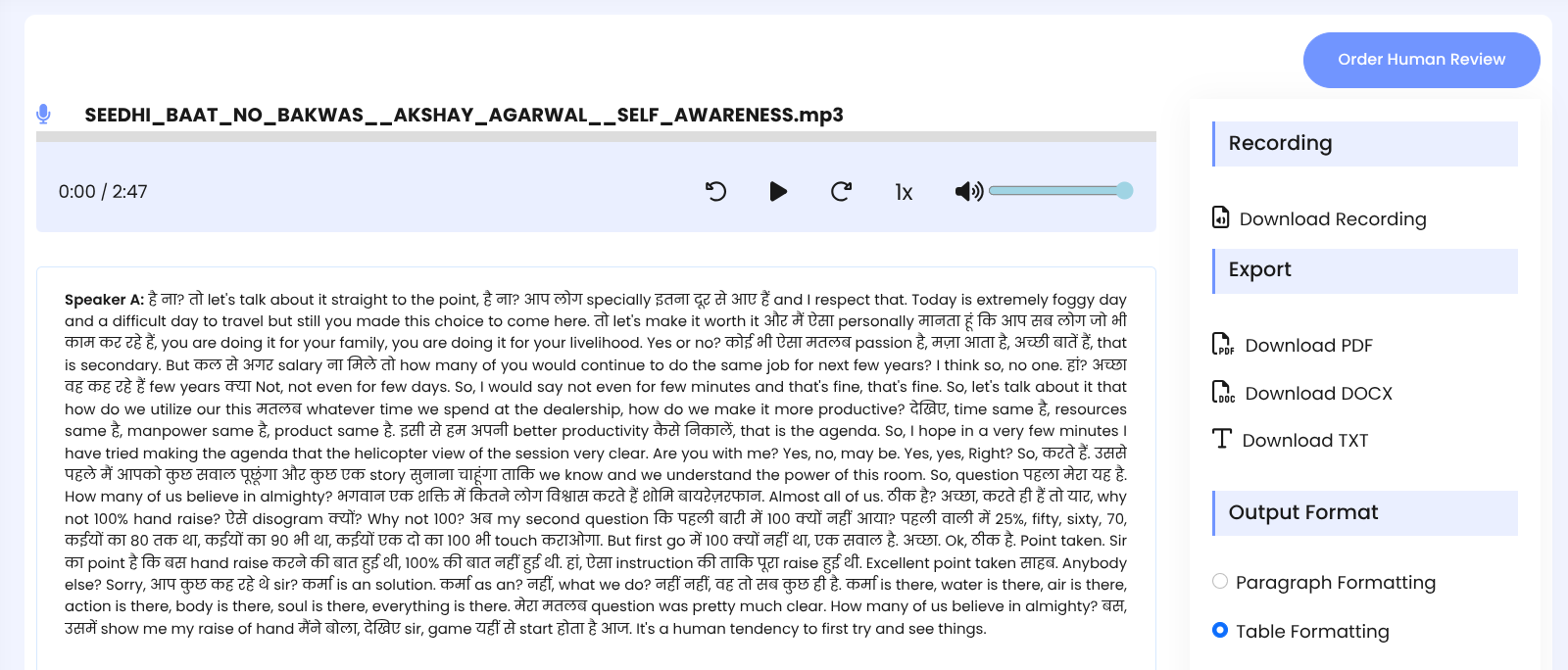
DictaAI’s AI transcription software is designed to handle real-world conversations, including mixed-language discussions that are common across India.
Instead of forcing speech into a single-language framework, DictaAI understands Hindi and English in the same conversational flow. It captures natural sentence structure, maintains readability, and preserves business terminology accurately.
The result is clean transcripts that are immediately usable.
These transcripts can then be transformed into summaries, insights, reports, or documentation without the need for heavy manual correction. Teams can review calls, extract action points, and analyze discussions confidently.
Rather than spending time fixing transcription errors, businesses can focus on extracting value from conversations.
The impact of accurate Hinglish transcription extends across departments.
Sales teams can review calls and identify key objections or commitments without second-guessing the transcript. Managers can document internal strategy discussions clearly. Customer support teams can analyze feedback and sentiment more effectively. Media and content teams can convert interviews into articles or scripts without struggling through inaccurate text.
When AI transcription services align with how people actually speak, adoption becomes natural. Teams trust the output. Decision-making becomes smoother.
Also Read: Beyond Note-Taking: How DictaAI’s AI Notetaker Enables Secure, Automated Enterprise Meetings
India is multilingual by design. Hybrid language usage is not going away. In fact, it is becoming more common in digital-first workplaces.
AI transcription tools that fail to adapt to mixed-language communication risk becoming outdated in the Indian market. Hinglish support will not remain a premium feature for long. It will become a baseline expectation.
Businesses want AI that reflects their reality, not AI that forces them to change how they speak.
Hinglish transcription is not just an added feature. It fills a critical gap in AI transcription for India.
By supporting accurate Hinglish speech-to-text, DictaAI ensures that conversations are captured the way they are spoken with context, clarity, and meaning intact.
Because the future of AI transcription in India isn’t about choosing between Hindi and English.
It’s about understanding both, together.

Comments
Glynnis Campbell
This is a test comment!