
Productivity today is no longer about how many hours people work. It is about how effectively work moves forward. In modern organizations, that forward motion begins with conversations. Meetings, calls, interviews, and discussions are where ideas form, decisions are made, and direction is set.
The problem is that once those conversations end, much of their value disappears. Notes are incomplete, recordings are rarely revisited, and critical decisions live only in people’s memories.
This is exactly the gap AI transcription services are designed to close. By turning spoken conversations into clear, searchable, and usable records, AI transcription helps teams convert discussion into real, measurable output.
Productivity is best understood as the value produced per hour of human effort. It is not about doing more tasks. It is about achieving better outcomes with the same amount of time.
In knowledge driven environments, productivity depends on how easily information can be retrieved, how clearly decisions are documented, and how quickly teams move from discussion to execution.
When teams struggle to recall what was agreed upon or waste time searching for past decisions, productivity suffers even when everyone is busy.
This challenge is especially visible in service based industries like consulting, technology, education, legal services, and corporate operations. These sectors rely heavily on spoken interactions. When conversations are poorly captured, valuable knowledge is lost and progress slows.
Global productivity research reflects this reality. Labor productivity growth has slowed across many economies, particularly in service led sectors where meetings and coordination dominate daily work. A major contributor is the loss of usable information after conversations, which leads to repeated discussions, delayed execution, and unnecessary follow ups.
The issue is not that teams talk too much. It is what happens after they talk.
Conversations are easy to forget. Notes capture fragments. Recordings are time consuming to review. As a result, decisions get revisited unnecessarily, and follow up meetings are scheduled just for alignment.
AI transcription software removes the need for parallel manual documentation. Conversations are captured accurately as they happen, without distracting participants from the discussion itself.
Meetings, calls, and interviews become immediate, usable assets instead of one time events. Spoken information does not disappear. It becomes searchable, shareable, and reusable.
This shift fundamentally changes how organizations handle knowledge. Documentation is no longer a separate task. It becomes part of the workflow.
The real value of AI transcription services lies in how quickly information becomes usable.
With accurate, searchable transcripts, teams do not need to rewatch recordings, decisions and action items are easy to locate, and context is preserved and shared consistently.
Transcripts can be reused across multiple functions, including internal reporting, training, compliance documentation, and content creation. What once required repeated human effort becomes a single source of truth.
By reducing friction in information access, AI transcription services help teams move faster without increasing workload.
Also Read: How Does an AI Transcription Service Handle Background Noise?
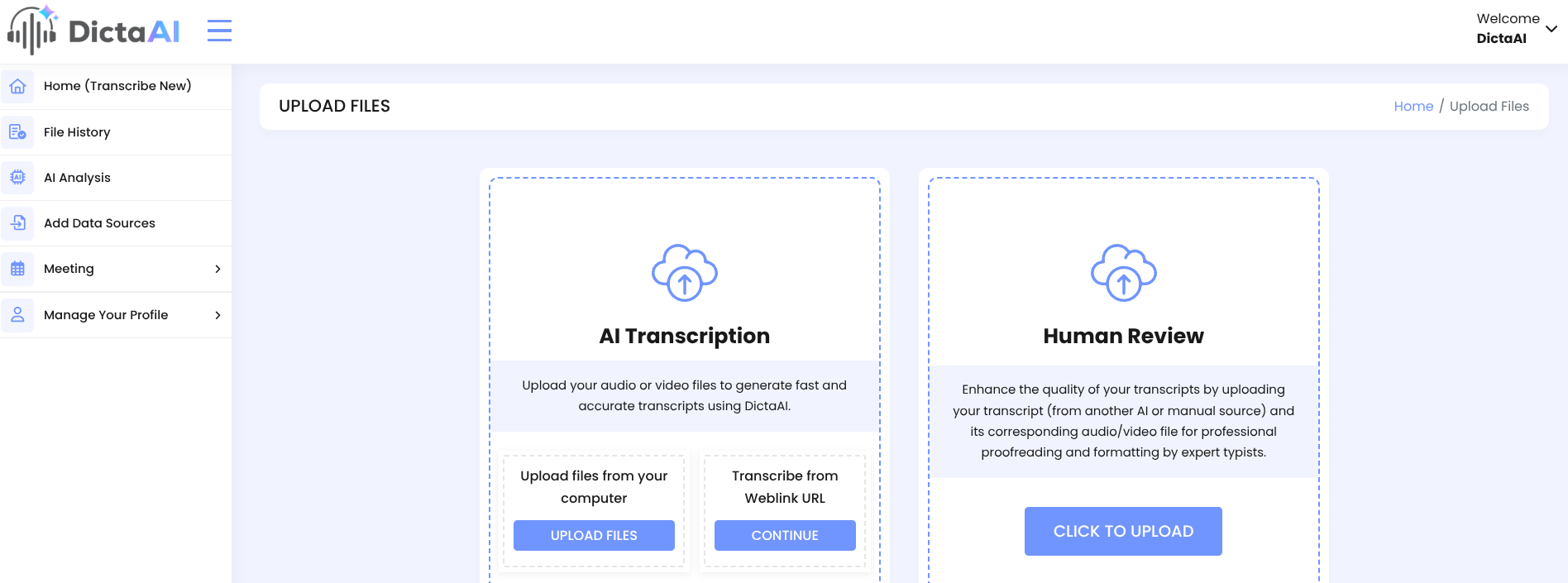
DictaAI is built for how work actually happens. Real conversations include interruptions, overlapping dialogue, varied accents, and imperfect audio. DictaAI’s AI transcription services are designed to handle these conditions across meetings, interviews, and client calls.
DictaAI goes far beyond basic transcription by turning conversations into a searchable, connected intelligence layer. With DictaLens, transcripts are no longer standalone files. You can search across multiple recordings at once, upload project-related PDFs or reference documents, and query everything together in a single workspace.
It lets you ask questions across conversations and documents, surface patterns, extract insights, and track decisions across meetings and materials. Transcripts become living assets that support faster analysis, clearer alignment, and real execution, not just records stored away.
Built to support a wide range of workflows, DictaLens helps media creators, business teams, educators, researchers, legal professionals, and podcasters turn transcripts into usable outputs, from summaries and briefs to content drafts, insights, and structured documentation. No matter the field, DictaLens transforms basic documents & information into tools that move work forward.
Key productivity advantages include:
How do AI transcription services improve Labor productivity?
They eliminate manual note taking and repeated clarification by capturing conversations once and making them reusable across tasks and teams.
Why does manual documentation reduce output per hour?
It divides attention during meetings and adds extra work afterward, leading to missed details and slower execution.
Can AI transcription software really save time in meetings?
Yes. Accurate transcripts reduce follow ups, eliminate replaying recordings, and improve alignment.
How does an AI transcription tool turn conversations into business assets?
It converts speech into searchable, structured text that supports reporting, training, compliance, and knowledge sharing.
Which teams benefit most from AI transcription services?
Knowledge driven teams in consulting, technology, education, legal services, and corporate operations see the strongest gains.

Comments
Glynnis Campbell
This is a test comment!